

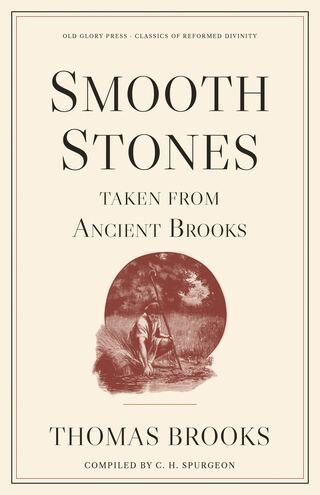
The title page says “By Rev. C. H. Spurgeon,” and so it was: Spurgeon compiled the book and wrote its Preface. But the choosing of its 899 passages was done by someone else, a young woman who did not yet share his name and who doubted she was equal to the task. Smooth Stones Taken from Ancient Brooks is the first fruit of one of the great partnerships of the Victorian church.
“An Ancient, Rusty-Looking Book”
Susannah Thompson met Charles Spurgeon soon after he came, not yet twenty, to preach at New Park Street Chapel in London. They were engaged, and during the engagement he gave her a task. Many years later she told the story herself, in the Autobiography she compiled after his death. He brought her “an ancient, rusty-looking book” by the Puritan Thomas Brooks, and asked her to mark “all those paragraphs and sentences” that struck her “as being particularly sweet, or quaint, or instructive.”
Her biographer says she undertook it “with much fear and trembling.” It was, she wrote, “the simplest kind of literary work,” yet to her it seemed
a most important and difficult task to discover in that ‘dry’ old book the bright diamonds which he was sure were hidden there.
— Susannah Spurgeon, C. H. Spurgeon’s Autobiography, vol. 2
She found them. Her marked passages became the body of the book. “I think the compilers were well pleased,” she wrote, “with the results of their happy work together.” They were married at New Park Street on 8 January 1856.
Spurgeon’s Preface
The book appeared in London from the publisher W. H. Collingridge, with a short Memoir of Brooks drawn from the old accounts of the ministers ejected in 1662, and a Preface signed “C. H. Spurgeon.” The Preface is three paragraphs long and has been quoted ever since:
As a writer, Brooks scatters stars with both his hands: he hath dust of gold; in his storehouse are all manner of precious stones.
— C. H. Spurgeon, Preface
The title is a pun on the author’s name, and Spurgeon turned it into a charge. Like David, who chose five smooth stones out of the brook before he went out against Goliath (1 Samuel 17:40), the reader was to take up these sayings as weapons: “Use these ‘smooth stones’ as David of old, and may the Lord direct them to the very forehead of thy sins.” And he said how the book should be read: “One of these pithy extracts may assist our meditations for a whole day.”
The Beginning of a Writing Life
Susannah’s biographer Charles Ray called Smooth Stones “Mrs. Spurgeon’s first literary effort.” It was far from her last. In 1875, after reading a proof of her husband’s Lectures to My Students, she said she wished she could place it in the hands of every minister in England, and from that wish grew her Book Fund, which sent theological books to ministers too poor to buy them for the rest of her life. She told its story in Ten Years of My Life in the Service of the Book Fund. She wrote three small devotional books, A Carillon of Bells, A Cluster of Camphire, and A Basket of Summer Fruit, and after her husband’s death in 1892 she compiled, with his secretary Joseph Harrald, the four volumes of C. H. Spurgeon’s Autobiography. She died in 1903.
The first of all those books was a courting couple’s little collection of Puritan sentences. Read with that in mind, the book has a second voice in it: not only Brooks, and not only Spurgeon, but the young reader who sat with a rusty old volume and a pencil, looking for diamonds.
Reading It Today
The sayings range over the whole Christian life: faith and prayer, sin and temptation, affliction and comfort, assurance, humility, the world, and the riches of Christ. The Old Glory Press edition gives the complete London text, numbers every stone, and adds a new Index of Subjects of more than ninety headings, so a reader can follow Spurgeon’s advice and take one stone a day, or turn straight to what Brooks says on a present need. Read more about Thomas Brooks.
Sources
- C. H. Spurgeon’s Autobiography, Compiled from His Diary, Letters, and Records, by His Wife and His Private Secretary, vol. 2 (London: Passmore and Alabaster, 1898), pp. 19–20.
- Charles Ray, The Life of Susannah Spurgeon (London: Passmore and Alabaster, 1903).
- C. H. Spurgeon, Preface to Smooth Stones Taken from Ancient Brooks (London: W. H. Collingridge).
Read the Stones She Chose
Smooth Stones Taken from Ancient Brooks: all 899 sayings, complete, with Spurgeon’s Preface, every stone numbered, and a new Index of Subjects.
 Also on Kindle, $0.99 →
View book details →