

Few Puritans are quoted as often as Thomas Brooks, and few left so little record of themselves. He wrote no memoir, and the accounts of his life written soon after his death are short. What survives is a London pastor’s career through civil war, ejection, plague, and fire, and a shelf of books so full of vivid sayings that C. H. Spurgeon could gather 899 of them into one small volume.
Cambridge and the Fleet
Brooks was born in 1608, probably into a Puritan family. On 7 July 1625 he matriculated at Emmanuel College, Cambridge, the college that trained so many Puritan ministers of his generation. He was probably licensed to preach about 1640. In the years of the civil war he served as chaplain to Rainsborough, the admiral of the parliamentary fleet, and afterwards to the admiral’s son, Colonel Thomas Rainsborough, whose funeral sermon he preached in November 1648.
A London Pulpit
By 1648 Brooks was preacher at St. Thomas Apostle in the City of London. On 26 December of that year he preached before the House of Commons, and he was invited back on 8 October 1650. In 1652 or 1653 he moved to St. Margaret’s, Fish Street Hill, near London Bridge. Part of the parish opposed him, and he answered his critics in print. In 1652 he published the book he is best known for, Precious Remedies against Satan’s Devices, and the books came steadily after it: Heaven on Earth on assurance (1654), The Unsearchable Riches of Christ (1655), and The Mute Christian under the Smarting Rod (1659).
He was a very affecting preacher, and useful to many. Though he used many homely phrases, and sometimes too familiar resemblances … he did more good to souls than many who deliver the most exact compositions.
— The Memoir, after Calamy’s account of the ejected ministers
Ejected, Plague, and Fire
In 1662 the Act of Uniformity removed Brooks from his pulpit, with some two thousand other ministers who would not conform. He did not leave London. His farewell address to his people took no text. It answered three questions on the loss of the gospel and then left them a list of “legacies,” beginning “Secure your interest in Christ.” He went on ministering to a congregation in Moorfields.
When the plague came in 1665 he stayed at his post and wrote A Heavenly Cordial for those who had survived it. That same year he published The Privy Key of Heaven, on private prayer. The next year the Great Fire destroyed much of the City; Brooks reflected on it in London’s Lamentations (1670). Richard Baxter named him among the Independent ministers who opened their meetings more publicly after the fire.
Last Years
His first wife, Martha, died about 1676, and Brooks published an account of her Christian experience with her funeral sermon. He married again, a young woman named Cartwright, not long after. He made his will in March 1680 and died on 27 September 1680, aged seventy-two. John Reeve preached his funeral sermon.
The Man in His Sentences
Brooks wrote for ordinary hearers, and he taught with pictures: the bee, the rod, the candle, the merchant’s ship, the soldier’s armor. His contemporaries noticed the “homely phrases” and “familiar resemblances,” and so did Spurgeon, who wrote in the Preface to his collection:
As a writer, Brooks scatters stars with both his hands: he hath dust of gold; in his storehouse are all manner of precious stones.
— C. H. Spurgeon, Preface to Smooth Stones Taken from Ancient Brooks
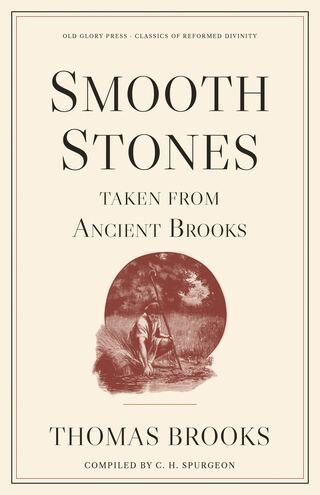
That is why he lends himself to a book of sayings. A single sentence of Brooks often holds a whole sermon: “Sin is bad in the eye, worse in the tongue, worse still in the heart, but worst of all in the life.” Spurgeon’s little collection, Smooth Stones Taken from Ancient Brooks, gathers 899 of them. Its passages were chosen by Susannah Thompson before she became Mrs. Spurgeon; the story of how she chose them is worth reading on its own.
The complete works of Brooks were edited by Alexander Grosart and printed in six volumes at Edinburgh in the 1860s. They remain in print today, and his Precious Remedies is still among the most widely read of all Puritan books.
Sources
- J. H. Thorpe, “Brooks, Thomas,” Dictionary of National Biography, vol. 6 (1886), with its list of first editions.
- Edmund Calamy and Samuel Palmer, The Nonconformist’s Memorial (1802), vol. 1, the entry on Brooks; adapted as the Memoir in Smooth Stones Taken from Ancient Brooks.
- C. H. Spurgeon, Preface to Smooth Stones Taken from Ancient Brooks (London: W. H. Collingridge).
- “Thomas Brooks,” Banner of Truth author biography.
Brooks in 899 Sentences
Smooth Stones Taken from Ancient Brooks: Spurgeon’s collection of Brooks’s sayings, complete, with every stone numbered and a new Index of Subjects.
 Also on Kindle, $0.99 →
View book details →