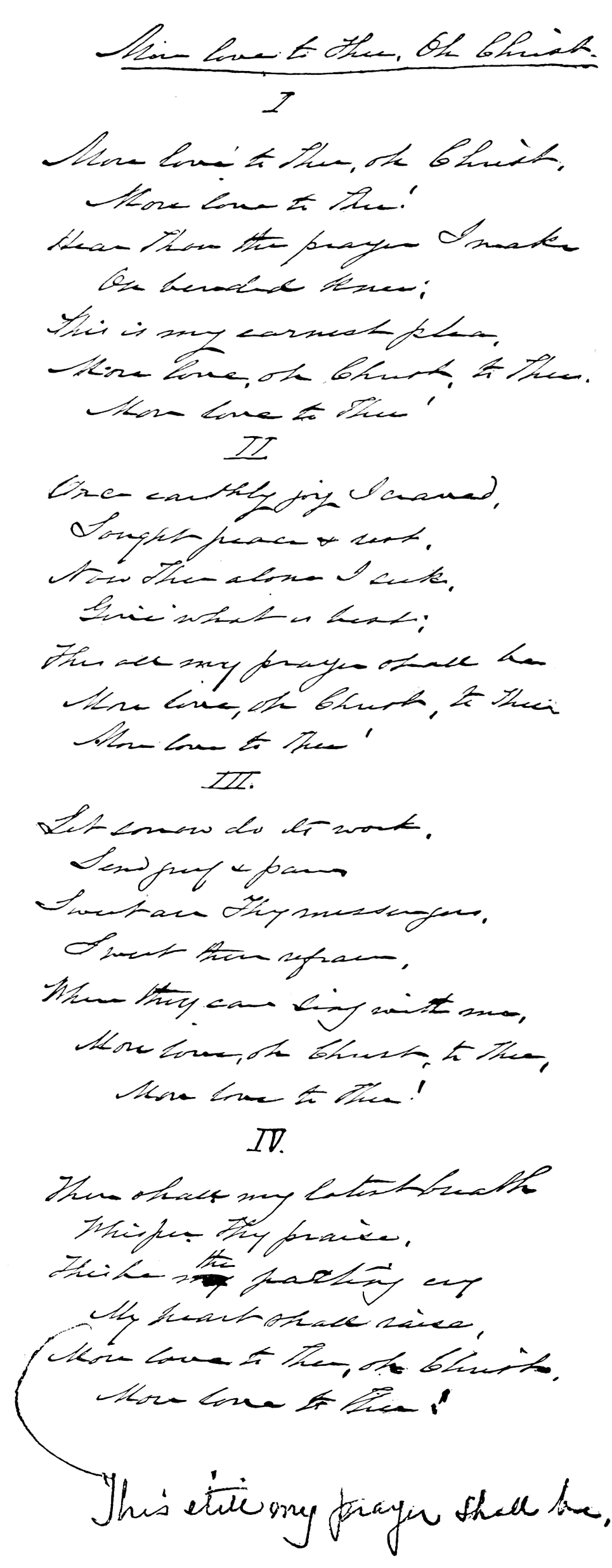
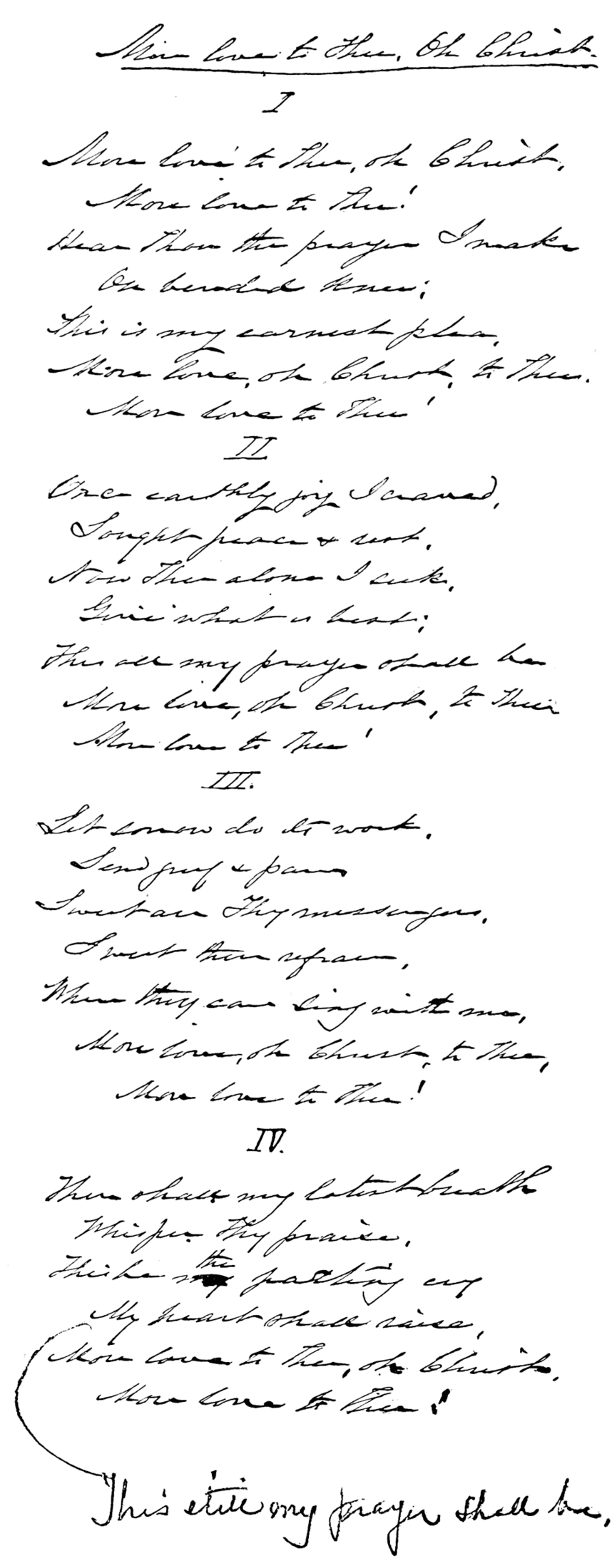
The handwriting above belongs to a woman who once described herself as having "empty hands, a worn-out, exhausted body, and unutterable longings to flee from a world that has so many sharp experiences." Yet from those empty hands came one of the most beloved hymns in the English language and a novel that has comforted Christian women for over 150 years.
Her name was Elizabeth Payson Prentiss.
A Pastor's Daughter in Portland, Maine
Elizabeth was born on October 26, 1818, in Portland, Maine, the fifth of eight children born to the Rev. Edward Payson and Ann Shipman Payson. Only six of the Payson children survived infancy. Her father was one of the most eminent Congregationalist pastors of his era — a man whose sermons drew crowds and whose piety was renowned throughout New England. The Payson household gathered for prayer three times a day.
Elizabeth adored her father, and his death from tuberculosis on October 22, 1827 — just days before her ninth birthday — left a wound that would shape her writing for the rest of her life. The loss of a father is the opening note of Stepping Heavenward, and it was not fiction. It was memory.
The family moved to New York City in 1831, where the twelve-year-old Elizabeth made a public profession of faith at the Bleecker Street Presbyterian Church. By sixteen, her sharp mind and gift for language had already found an outlet: she was a regular contributor of stories and poems to The Youth's Companion, a popular New England religious periodical.
Teacher, Wife, and Mother
In 1838, Elizabeth opened a small girls' school in her Portland home. Two years later, she accepted a teaching position at a girls' boarding school in Richmond, Virginia, where she was beloved by her students despite chronic health problems — headaches lasting days at a time, dizziness, depression, and insomnia that no doctor could explain.
On April 16, 1845, she married the Rev. George Lewis Prentiss, a Congregational minister and the brother of her close friend Anna Prentiss Stearns. The couple settled in New Bedford, Massachusetts, where George pastored the South Trinitarian Church and Elizabeth assumed the quiet, demanding role of a pastor's wife — bringing comfort to the sick and bereaved while managing a growing household.
Elizabeth had six children. Only four survived infancy.
The School of Suffering
In 1852, within a span of three months, Elizabeth lost two children: her son Eddy, age four, died in January, and her newborn daughter Bessie died in April. Elizabeth herself nearly died from a postnatal infection and was quarantined from Bessie — holding her newborn only twice, once the day before the baby died and once as she was dying.
In her grief-stricken exhaustion, she repeated over and over: "God never makes a mistake. God never makes a mistake."
Among her papers after her death, a poem was found on a scrap of paper, written in pencil:
I thought that prattling boys and girls
Would fill this empty room;
That my rich heart would gather flowers
From childhood's opening bloom.One child and two green graves are mine,
— "My Nursery," 1852
This is God's gift to me;
A bleeding, fainting, broken heart —
This is my gift to Thee.
A Writer Forged by Sorrow
After thirteen years with no published writing, Elizabeth returned to the page in 1853. Her children's book Little Susy's Six Birthdays — written in just ten days — was an immediate success. Over the next two decades, she would write more than 25 books: children's stories, novels, poetry, and hymns.
Her 1856 novel The Flower of the Family was her first great success, translated into French and German. She also wrote the children's poem "Mr. Nobody" — a classic still recited today, though often misattributed to anonymous or to Walter de la Mare.
But the work that made her immortal came in 1869.
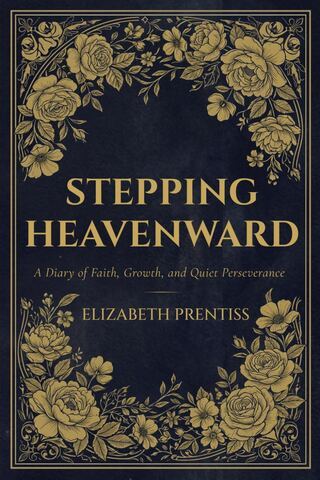
Stepping Heavenward (1869)
Stepping Heavenward was published in installments by the Chicago Advance in 1869 and went on to sell over 300,000 copies worldwide. It became a staple of Sunday school libraries and a book that Christian women passed from mother to daughter, generation after generation.
The novel is written as the diary of Katherine Mortimer, who — like Elizabeth — lost her father young, buried a child, and struggled with chronic illness. Katherine's voice is candid, sometimes humorous, often achingly vulnerable. Through her, Elizabeth crafted a portrait of the Christian life where doubt and impatience give way, slowly and painfully, to grace.
Of writing it, Elizabeth said simply: "Every word of that book was a prayer, and seemed to come of itself."
The Old Glory Press edition of Stepping Heavenward includes two rare introductions from the 1900 Pennypacker edition — a Sketch of the Author and The Story of the Book by her husband George — unavailable in most modern printings.
The Hymn She Hid for Thirteen Years
In 1856, Elizabeth's daughter Minnie fell critically ill. The doctors told the family to prepare for the worst. Minnie survived, but the experience — coming just four years after the deaths of Eddy and Bessie — broke something open in Elizabeth.
Inspired by Sarah Adams' hymn "Nearer, My God, to Thee," Elizabeth sat down one evening and wrote all four stanzas of "More Love to Thee, O Christ" in a single sitting.
Then she put it away. She never showed it to anyone — not her husband, not her friends — for thirteen years.
In 1869, the same year Stepping Heavenward was published, the hymn finally appeared as a printed leaflet. The following year, the composer William Howard Doane (1832–1915) set it to music under the tune name MORE LOVE TO THEE, publishing it in Songs of Devotion for Christian Associations (1870). It quickly became one of the most widely sung hymns in the English-speaking world and has been published in more than 850 hymnals.
Full Text of "More Love to Thee, O Christ"
More love to Thee, O Christ, more love to Thee!
Hear Thou the prayer I make on bended knee;
This is my earnest plea:
More love, O Christ, to Thee,
More love to Thee! More love to Thee!Once earthly joy I craved, sought peace and rest;
Now Thee alone I seek, give what is best;
This all my prayer shall be:
More love, O Christ, to Thee,
More love to Thee! More love to Thee!Let sorrow do its work, send grief and pain;
Sweet are Thy messengers, sweet their refrain,
When they can sing with me:
More love, O Christ, to Thee,
More love to Thee! More love to Thee!Then shall my latest breath whisper Thy praise;
This be the parting cry my heart shall raise;
This still its prayer shall be:
More love, O Christ, to Thee,
More love to Thee! More love to Thee!
On August 13, 1878, Elizabeth Prentiss died at her summer home in Dorset, Vermont. She was fifty-nine years old. At her funeral, the congregation sang "More Love to Thee, O Christ."
Her Legacy
Elizabeth Prentiss spent most of her life in the ordinary — raising children, keeping house, enduring illness, writing letters. She spent about three days a week in bed with a headache. She buried two children. She suffered from insomnia so severe it never fully relented.
And yet from that life came a novel that has comforted millions, a hymn that has been sung for over 160 years, and a testimony that suffering, when surrendered to God, can become the deepest source of ministry to others.
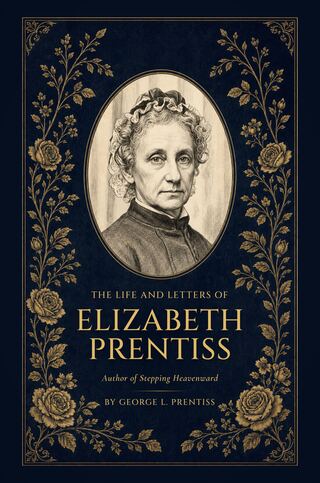
In one of her last letters, she wrote the words that would serve as the epigraph to her husband's 1882 biography, The Life and Letters of Elizabeth Prentiss:
"Much of my experience of life has cost me a great price and I wish to use it for strengthening and comforting other souls."
Read Her Work—and the Life Behind It
Stepping Heavenward gives the beloved devotional novel; The Life and Letters of Elizabeth Prentiss gives the letters, journals, and experiences from which it grew.
View Life and Letters details →