
He was the most learned man in Puritan England, and for six years he governed its greatest university. He preached to Parliament the morning after a king was beheaded, rode with Cromwell's army into Ireland and Scotland, and was offered the presidency of Harvard. And yet the books that carried his name down the centuries were not his works of statecraft or his towering volumes of doctrine, but a handful of small, searching treatises on the oldest problem in the Christian life: what to do about the sin that will not leave a believer alone.
His name was John Owen.
A Minister's Son in Oxfordshire
John Owen was born in 1616 — the year Shakespeare died — at Stadhampton, a village in Oxfordshire, the second son of Henry Owen, the Puritan vicar of the parish. "I was bred up from my infancy," Owen later wrote, "under the care of my father, who was a Nonconformist all his days, and a painful labourer in the vineyard of the Lord." It was a home of plain, earnest, dissenting religion, and it stamped him for life.
He was a boy of unusual ability. He entered Queen's College, Oxford, at about the age of twelve, took his Bachelor's degree in 1632 and his Master's in 1635, and threw himself into study with a ferocity that told on his health — he is said to have allowed himself only four hours of sleep a night. But the rising tide of William Laud's ceremonial reforms made Oxford an increasingly uncomfortable place for a man of Puritan conviction, and around 1637 Owen left the university rather than conform, taking work as a private chaplain and tutor.
A Long Darkness, and an Unknown Preacher
For all his learning, Owen passed through a long season of spiritual distress, unsure of his own standing before God. Deliverance came, as it so often did in that age, through a sermon — and through one of the quiet providences he would later teach others to trust.
Having gone to hear a celebrated London preacher who failed to appear, Owen stayed to listen to an unknown country minister preach in his place. The text was Matthew 8:26 — "Why are ye fearful, O ye of little faith?" The plain man never learned whose doubts he had answered that day, but the sermon settled Owen's soul in the assurance he had been reaching after for years. The experience marked all his later writing: no one has written more searchingly about the inner life of faith, or with more tenderness toward the struggling believer, than the man who had walked so long in the dark himself.
"Sin is never less quiet than when it seems to be most quiet, and its waters are for the most part deep when they are still."
— John Owen, The Mortification of Sin
Pastor, Preacher to Parliament, and Chaplain to Cromwell
Owen's first book, A Display of Arminianism (1643), won him notice and a country living at Fordham in Essex, and then a larger charge at Coggeshall, where his congregation swelled and where he came to embrace the Congregational (Independent) way of ordering the church — the conviction that each gathered company of believers is a complete church under Christ. It was a position he would defend for the rest of his life.
The Civil Wars carried him onto a larger stage. He preached before Parliament on several occasions, including the day after the execution of Charles I in January 1649 — a sermon in which, remarkably, he never mentioned the event that had convulsed the nation the day before. His gifts drew the notice of Oliver Cromwell, who took him as a chaplain on the campaigns to Ireland (1649) and Scotland (1650). "Sir," Cromwell is said to have greeted him, "you are the person I must be acquainted with."
Vice-Chancellor of Oxford
In 1651 Cromwell, as Chancellor of the University, installed Owen as Dean of Christ Church, and the following year as Vice-Chancellor of the University of Oxford — the working head of the whole university, which he governed from 1652 to 1657. He proved an able and surprisingly moderate administrator, restoring order and learning to a university battered by war, and protecting scholars who did not share his own convictions.
It was in these Oxford years, at the height of his public power, that Owen wrote his most enduring books for the ordinary Christian. Out of sermons preached to the university came The Mortification of Sin (1656), together with its companions Of Temptation and, a little later, The Nature, Power, Deceit, and Prevalency of Indwelling Sin. The most public man in Puritan England was, at the same time, its most penetrating anatomist of the secret warfare of the heart.
The Books That Outlived Him
Owen's pen was extraordinarily productive, and his works fill many volumes. Among the greatest:
- The Mortification of Sin (1656) — his most loved book, on putting indwelling sin to death by the Spirit.
- The Death of Death in the Death of Christ (1647) — his classic defense of particular redemption.
- Communion with God — on the believer's distinct fellowship with the Father, the Son, and the Holy Spirit.
- The Glory of Christ — his last work, on beholding Christ by faith, finished as he lay dying.
- Pneumatologia — his great discourse on the person and work of the Holy Spirit.
- His vast commentary on the Epistle to the Hebrews — the labor of decades.
Ejected, but Never Silenced
The Restoration of the monarchy in 1660 swept Owen out of public life. As a leading Independent he lost his Oxford offices, and the Act of Uniformity of 1662 drove him and some two thousand Puritan ministers out of the Church of England. The decades that followed were years of persecution for Nonconformists, and Owen shared in the danger, though his fame and his old connections afforded him a measure of protection that many humbler dissenters never enjoyed.
He gathered and pastored an Independent congregation in London, wrote steadily in defense of Nonconformity and toleration, and became a kind of elder statesman of the persecuted Puritan cause. So great was his reputation across the Atlantic that he was invited to become president of Harvard College — an honor he declined, choosing to remain with his people in England.
A Life Acquainted with Grief
Owen's public eminence was shadowed by deep private sorrow. He married Mary Rooke, and of their many children — eleven by the common account — all but one died in childhood, and the daughter who reached adulthood died not long after. The man who wrote so unforgettably about mortifying sin and beholding the glory of Christ did so as one well schooled in loss, who had followed most of his own children to the grave.
The Glory of Christ, at the Last
Owen died on August 24, 1683, at Ealing, worn out with study, labor, and affliction. On the morning of his death a friend brought word that his last book, The Glory of Christ, was in the press. "I am glad to hear it," Owen answered; "but, O brother Payne, the long-wished-for day is come at last, in which I shall see that glory in another manner than I have ever done, or was capable of doing in this world." He was buried in Bunhill Fields, the great burial-ground of London's Nonconformists, where his tomb still stands among those of Bunyan and Watts.
He had been the head of a university and the confidant of a Protector; but the books by which he is still read are the small, searching ones he wrote for the good of ordinary souls — and none more than his treatise on the killing of sin.
Read Owen's Most Loved Book
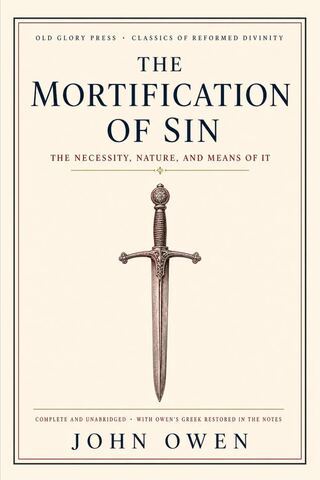
The Mortification of Sin — John Owen's searching classic on putting sin to death by the Spirit (Romans 8:13). Complete and unabridged, with Owen's own preface, a new reader's introduction, and his Greek restored in the notes.