

For more than forty-five years, Londoners crowded into St Anne Blackfriars to hear the same minister. He preached twice every Sunday, sustained a Wednesday lecture for thirty-five years, raised money for a church building, trained students, wrote enormous books—and still found time to become one of the most constant workers at the Westminster Assembly.
His name was William Gouge, and the book for which he is best remembered began not in a scholar's study but in sermons preached to the households of his own congregation.
A Date in Dispute
Even Gouge's birth date requires care. The life written by his son gives November 1, 1575, at Stratford-le-Bow in Middlesex. A later biographer found a King's College register giving December 25, 1578. Most modern references retain 1575, but the documentary conflict is real; “traditionally 1575–1653” is the safest brief form.
He came from a strongly Protestant family. His maternal uncles Samuel and Ezekiel Culverwell were preachers, while two of his mother's sisters married the Cambridge divines Laurence Chaderton and William Whitaker. Gouge studied at St Paul's School, Felsted, and Eton before entering King's College, Cambridge, in 1595.
The “Arch-Puritan” of King's College
At Cambridge, Gouge became known for logic, philosophy, and Hebrew. He defended the method of the French logician Peter Ramus and was reportedly the one steadfast student of a Jewish teacher who came to Cambridge to teach Hebrew. His strict habits and regular attendance at prayer earned him the college nickname “arch-puritan.”
He graduated B.A. in 1598, became a fellow of King's, proceeded M.A. in 1602, and lectured in logic and philosophy. In 1604 he left Cambridge at his father's wish to marry Elizabeth Caulton. Their household would eventually include seven sons and six daughters; eight of the thirteen children survived to adulthood.
Forty-Five Years at Blackfriars
Gouge took holy orders in 1607. The next year Arthur Hildersham recommended him to preach at St Anne Blackfriars in London. He first served as lecturer and, after Stephen Egerton's death in 1621, as rector. The parish initially had no church of its own; Gouge helped raise more than £1,500 for a building and its enlargement.
His ministry was unusually settled. He preached two sermons each Sunday and a Wednesday lecture that remained popular for thirty-five years. Contemporaries remembered both the scale of his work and the gentleness of his manner. Later London Presbyterians called him “the father of the London ministers.”
A Pastor Writes About the Household
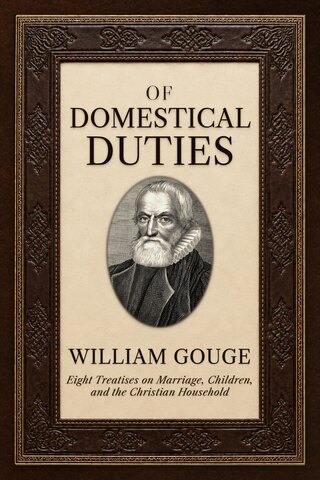
Gouge first preached the substance of Of Domestical Duties to his congregation, then expanded it for publication in 1622. The work follows Paul's household teaching in Ephesians 5:21–6:9 through eight treatises: the basis of domestic duties; the married relation; duties shared by spouses; duties particular to wives and husbands; then the duties of children, parents, servants, and masters.
The book is sometimes reduced to a few quotations about authority. Its actual method is more demanding. Every relation produces duties on both sides, and those with greater earthly authority receive extensive obligations. Husbands must love, provide, and dwell wisely; parents must educate without provoking; masters must pay fairly, avoid cruelty, train servants for a calling, and remember that they themselves have a Master in heaven.
“A family is a little church, and a little commonwealth… a school wherein the first principles and grounds of government and subjection are learned.”
— William Gouge, Of Domestical Duties
Prison, Controversy, and Conscience
In 1621 Gouge edited and published Sir Henry Finch's The World's Great Restauration, a book about the future calling of the Jews. Political implications drawn from it displeased James I, and Gouge spent nine weeks in prison before securing release with a doctrinal explanation acceptable to Archbishop Abbot.
He later joined the Feoffees for Impropriations, a Puritan effort to purchase church income rights and support preaching ministers. The Court of Exchequer dissolved the scheme in 1633. Gouge also refused to read the Book of Sports, both in 1618 and 1633, because he believed its encouragement of Sunday recreation violated the Sabbath.
The Westminster Assembly
Parliament named Gouge to the Westminster Assembly in 1643. The old pastor was among its most assiduous members. He examined candidates for ministry, served on the committee drafting the Confession of Faith, helped arrange biblical proofs for Presbyterian church government, and was elected one of the Assembly's assessors in 1647.
He also worked on the Assembly's planned biblical annotations, receiving responsibility for 1 Kings through Esther. Although strongly Presbyterian, he did not become a political radical; like many ministers of his party, he denounced the trial of Charles I.
His Books and Final Work
Gouge published widely. Besides Of Domestical Duties, his works included The Whole Armour of God, A Guide to Go to God on the Lord's Prayer, God's Three Arrows on plague, famine, and war, and The Saints' Sacrifice on Psalm 116.
His largest project was a commentary on Hebrews embodying nearly a thousand sermons preached at Blackfriars. Despite asthma and painful illness, he worked on it until a week before his death. He died on December 12, 1653, and was buried in his church. His son Thomas saw the commentary into print in 1655.
Why Read Gouge Now?
Gouge should be read neither as a modern marriage counselor nor as a museum piece. He is a primary witness to how one major Puritan pastor understood the household: ordered by Scripture, structured by real authority, but governed under divine judgment and filled with reciprocal obligations. His social world is not ours. His determination to ask what love, justice, patience, provision, education, worship, and accountability require in every relation remains bracing.
Sources
- Thomas Gouge, “The Life of Dr. William Gouge,” prefixed to A Commentary on the Whole Epistle to the Hebrews (1655).
- Alexander Gordon, “Gouge, William,” Dictionary of National Biography, vol. 22 (1890).
- William Gouge, Of Domestical Duties (London, 1622).
Read William Gouge's Great Work on the Household
Of Domestical Duties — all eight treatises, complete and unabridged, with Gouge's family prayers for every member of the household.
 Buy the Paperback
View book details →