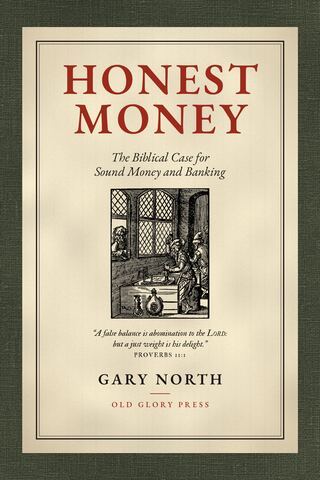
Honest Money
The Biblical Case for Sound Money and Banking

First published 1986 · 137 pages · Paperback
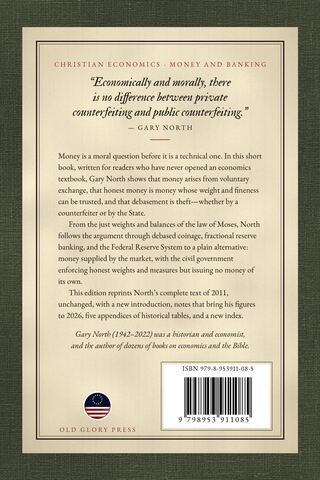
Money is a moral question before it is a technical one. In this short book, written for readers who have never opened an economics textbook, Gary North shows that money arises from voluntary exchange, that honest money is money whose weight and fineness can be trusted, and that debasement is theft, whether by a counterfeiter or by the State.
North begins where the Bible begins on the subject, with the law of Moses: “Just balances, just weights, a just ephah, and a just hin, shall ye have” (Leviticus 19:36). From there he follows the argument through debased coinage, fractional reserve banking, and the Federal Reserve System to a plain alternative: money supplied by the market, with the civil government enforcing honest weights and measures but issuing no money of its own. Read more about the Bible’s teaching on honest money.
North wrote plainly and enjoyed a fight. Readers need not accept all of his conclusions to profit from the book, for its central questions are as live now as in 1986: who may create money, what makes it honest, and what follows when a government does what it would punish a private man for doing.
About This Edition
- North’s complete text of 2011, unchanged — the Ludwig von Mises Institute edition of his 2005 revision, with his wording, spelling, and punctuation as he left them
- A new introduction that sets the book in its time and ours
- Notes that bring North’s figures to November 2026, each with its source, marked as the editor’s
- Five appendices: the purchasing power of the dollar since 1913, fixed incomes under inflation, the Federal Reserve’s balance sheet since 2008, gold and silver since 1792, and American business cycles since 1913
- An index keyed to this edition, with entries for the new matter
- 137 pages at 6 × 9 inches, with Jost Amman’s woodcut Der Müntzmeister (The Mint-Master, 1568) on the cover
“Economically and morally, there is no difference between private counterfeiting and public counterfeiting.”
— Gary North, Honest Money, chapter 6
Paperback · ISBN 979-8-953911-08-5
Part of Just Weights: Classics of Honest Money
The Author
Gary North (1942–2022)
Gary North was a historian by training and an economist by vocation. He took his doctorate in history at the University of California, Riverside, founded the Institute for Christian Economics in 1975, and served on the staff of Congressman Ron Paul. A Calvinist and a student of the Austrian School of Ludwig von Mises and Murray Rothbard, he wrote investment newsletters, a long economic commentary on the Bible, and dozens of shorter books, and he wanted his books to circulate.
Who was Gary North? →The Series
Just Weights: Classics of Honest Money
Honest Money is one of six volumes in Just Weights, which gathers the classic arguments for sound money, from Nicolas Oresme in the fourteenth century to Gary North in the twentieth: Oresme’s De Moneta, John Locke’s The Value of Money, Richard Cantillon’s Essay on the Nature of Trade in General, William M. Gouge’s A Short History of Paper Money and Banking, William Graham Sumner’s A History of American Currency, and North’s Honest Money.
See the six volumes →Questions About the Book
What is Honest Money about?
Gary North argues that money is a moral question before it is a technical one. Money arises from voluntary exchange; honest money is money whose weight and fineness can be trusted; and debasing it is theft, whether a counterfeiter does it or the State. From the just weights and balances of the law of Moses, North follows the argument through debased coinage, fractional reserve banking, and the Federal Reserve System to money supplied by the market, with the civil government enforcing honest weights and measures but issuing no money of its own. More on the book’s argument.
Is North’s text complete and unchanged?
Yes. This edition prints the complete text of the 2011 Ludwig von Mises Institute edition, North’s revision of the book first published in 1986. His wording, spelling, and punctuation are unchanged. Everything new, the introduction, the notes, and the appendices, is marked as the editor’s.
What does this edition add?
A new introduction; footnotes that bring North’s figures to November 2026 and give their sources; five appendices (the purchasing power of the dollar since 1913, fixed incomes under inflation, the Federal Reserve’s balance sheet since 2008, gold and silver since 1792, and American business cycles since 1913); and an index keyed to this edition.
Is this the book once subtitled The Biblical Blueprint for Money and Banking?
Yes. Honest Money first appeared in 1986 as Honest Money: The Biblical Blueprint for Money and Banking, and the 2011 Mises Institute edition kept that subtitle. This edition prints the 2011 text under the subtitle The Biblical Case for Sound Money and Banking. Read about Gary North.
Which formats are available?
The paperback is available on Amazon in the United States: 137 pages at 6 × 9 inches, ISBN 979-8-953911-08-5.