
“A false balance is abomination to the LORD: but a just weight is his delight.”
— Proverbs 11:1
The Bible has nothing to say about paper currency, central banks, or deposit insurance. It has a great deal to say about scales. In the world of the Old Testament, silver and gold passed from hand to hand by weight, so a merchant’s balance and the stones in his bag were the measure of the money itself. Whoever tampered with them tampered with the money. That is why the law, the wisdom books, and the prophets return again and again to just weights, and why Gary North could build a whole book on money, Honest Money, on a few verses about the marketplace.
Just Weights in the Law of Moses
The command comes twice in the law. In Leviticus it stands among the laws of holiness, with a reason attached:
“Ye shall do no unrighteousness in judgment, in meteyard, in weight, or in measure. Just balances, just weights, a just ephah, and a just hin, shall ye have: I am the LORD your God, which brought you out of the land of Egypt.” (Leviticus 19:35–36)
Deuteronomy names the trick it forbids, a bag holding two sets of weights, a heavy one for buying and a light one for selling:
“Thou shalt not have in thy bag divers weights, a great and a small. Thou shalt not have in thine house divers measures, a great and a small. But thou shalt have a perfect and just weight, a perfect and just measure shalt thou have: that thy days may be lengthened in the land which the LORD thy God giveth thee. For all that do such things, and all that do unrighteously, are an abomination unto the LORD thy God.” (Deuteronomy 25:13–16)
North reads these verses as the eighth commandment applied to trade. “The law regarding honest weights and measures,” he writes, “is obviously a specific (case-law) application of the eighth commandment: ‘Thou shalt not steal’ (Exodus 20:15).” But he notes that the Leviticus command carries more than a prohibition of theft. God gives the reason at once: he is the Lord who brought Israel out of Egypt. North draws the lesson that a people delivered from bondage had to keep the disciplines of freedom, beginning with honest dealing in the market, and that the scales are a picture of God’s own justice. “To tamper with the scales,” he writes, “is to defy God in a unique way.”
False Balances in Proverbs and the Prophets
The wisdom books put the matter just as sharply. “A just weight and balance are the LORD’S: all the weights of the bag are his work” (Proverbs 16:11). “Divers weights, and divers measures, both of them are alike abomination to the LORD” (Proverbs 20:10). The word abomination is a strong one, the same the law uses of idolatry.
The prophets made false weights part of their indictment of the nation. Amos quoted the merchants of Israel, impatient for the sabbath to end, “making the ephah small, and the shekel great, and falsifying the balances by deceit” (Amos 8:5): a short measure for the grain they sold and a heavy weight for the silver they took. Micah asked on God’s behalf, “Shall I count them pure with the wicked balances, and with the bag of deceitful weights?” (Micah 6:11).
“Thy Silver Is Become Dross”
Isaiah opens his prophecy with an image drawn from the smelter’s furnace: “Thy silver is become dross, thy wine mixed with water” (Isaiah 1:22). North takes it as the epigraph of his chapter on debasing the currency. “What is dross?” he asks. “It is cheap or ‘base’ metal.” Silver alloyed with tin still shines like silver, and few people own scales fine enough to detect the difference. The man who adds the tin keeps the silver he has saved and spends it as profit, and the people who trusted his ingots bear the loss. The prophet uses the image of a whole people’s corruption, and he promises that God will do what the rulers would not: “I will turn my hand upon thee, and purely purge away thy dross, and take away all thy tin” (Isaiah 1:25).
North observes that in Isaiah’s day the state did not issue coins. Its duty was to judge fraud, including the passing of debased silver. The temptation came later, he argues, when rulers learned that they could debase the coinage themselves and keep the profit.
From Scales to Money
From these texts North draws the principle that gives his book its name: “Honest money is an economic application of the law against false weights and measures.” Because money in the Bible is weighed metal, to tamper with its content is to tamper with the scales. He then carries the principle forward to paper. A banknote that promises a quantity of gold or silver is a warehouse receipt, and, North argues, “Issuing more receipts than there is metal to redeem them is a form of counterfeiting.” That conclusion sets him against fractional reserve banking, in which banks lend out money that depositors may demand at any moment, and against the Federal Reserve System, which he regards as its protector.
The argument comes to a point in one sentence: “Economically and morally, there is no difference between private counterfeiting and public counterfeiting.” A counterfeiter and a government that inflates its currency do the same thing to the same people, North holds, and the law of God does not exempt the State.
North’s Alternative
North’s positive proposal is modest in its machinery. The civil government should enforce honest weights and measures and punish fraud, as the law of Moses required, but it should not issue money itself. Money should be whatever free people choose to use, gold, silver, or something else, with no legal tender laws compelling anyone to accept a currency, no central bank, and no fractional reserves. “The Biblical view is clear,” he writes: “the State is not to be trusted with the right to issue money.”
Not every reader will follow North to all of his conclusions, and he did not expect them to without a fight. But the questions he puts to the biblical texts remain live: who may create money, what makes it honest, and what follows when a government does what it would punish a private man for doing. The Old Glory Press edition prints his complete text with notes that carry his figures forward. It now takes $3.07 to buy what $1 bought when the book first appeared in 1986.
Further Reading
- Gary North, Honest Money: The Biblical Case for Sound Money and Banking (Old Glory Press, 2026), from the 2011 Ludwig von Mises Institute edition. Quotations are from chapters 3, 4, 6, and 10.
- Who Was Gary North? A short life of the author.
- Just Weights: Classics of Honest Money, the six-volume series from Oresme to North.
- Scripture is quoted from the King James Version.
Read Honest Money
Gary North’s complete text, with a new introduction, notes that bring his figures to 2026, and five appendices of historical tables.
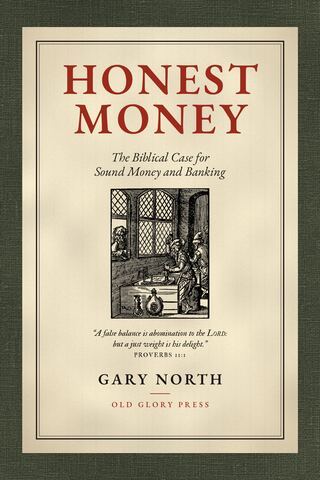 Paperback — $9.99
View book details →