A Classic 19th-Century Devotional on the Hymn "Take My Life and Let It Be" — Frances Ridley Havergal

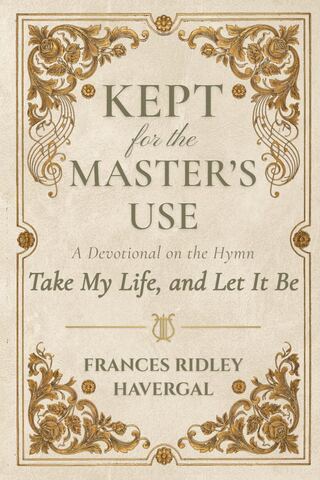
Originally published 1879 · Paperback edition
In the winter of 1874, Frances Ridley Havergal spent a few days as a guest at Areley House in Worcestershire. She set herself the quiet purpose of seeking to be used, during those days, as an instrument of blessing to every person under that roof. By the final evening, all ten — guests and servants alike — had been reached, and several had come to a new and decisive act of faith.
That night, too full of joy to sleep, she lay awake composing the lines that would become one of the most beloved consecration hymns in the English language: Take my life, and let it be. Verse by verse the hymn unfolded — hands, feet, voice, lips, silver, gold, intellect, will, heart, love, and finally the self-entire — each stanza a specific, concrete act of surrender.
Years later, she undertook to write out the full meaning of that covenant in prose. The result was Kept for the Master's Use — one chapter for each couplet of the hymn, addressed directly to the reader in Havergal's characteristic style: intimate, searching, warm, and full of Scripture. For Havergal, the hymn was not merely a poem but a covenant — one she returned to repeatedly, asking herself whether her surrender was as complete in practice as it was in intention.
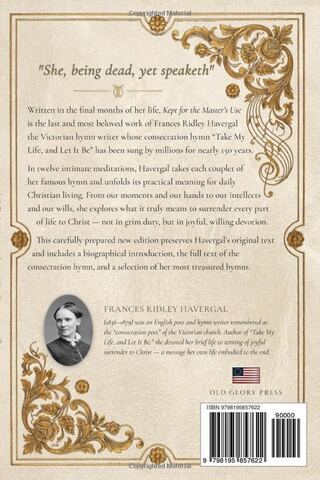
This was the last book Havergal completed. She corrected the final proofs just weeks before her death on June 3, 1879, at the age of forty-two. It stands as the fullest expression of her theology and her heart: a life entirely offered, and entirely kept.
This Old Glory Press edition presents Havergal's original text in a beautifully typeset format for a new generation of readers — complete with an introduction to the author and the remarkable story behind the hymn. For any reader who has ever sung Take My Life and wondered what it would mean to live it, this book is an indispensable companion.
Take my life, and let it be
— Frances Ridley Havergal, 1874
Consecrated, Lord, to Thee;
Take my moments and my days,
Let them flow in ceaseless praise.
About the Author

Frances Ridley Havergal was born on December 14, 1836, the youngest child of the Rev. William Henry Havergal — himself a clergyman and composer — and his wife Jane. She was named in honor of Bishop Nicholas Ridley, the Reformation martyr.
She could read before she was three, was writing verse by age seven, and over the course of her life committed to memory the entire Psalter, the book of Isaiah, the Minor Prophets, the four Gospels, the Epistles, and the book of Revelation. Her hymns — including "Take My Life and Let It Be," "Like a River Glorious," and "I Gave My Life for Thee" — have been sung by generations of Christians around the world.
She died on June 3, 1879, at the age of forty-two. Her last recorded word, spoken after a friend read from 1 John, was simply: "Wonderful."
Read her full biography →Kept for the Master's Use is Frances Ridley Havergal's devotional commentary on her own hymn "Take My Life and Let It Be," written in 1874. Each chapter unpacks one couplet of the hymn — hands, feet, voice, lips, silver, gold, will, heart, love, and self — examining what it truly means to surrender each area of life to God. It was the last book Havergal completed before her death in 1879.
"Take My Life and Let It Be" was composed by Havergal in February 1874 after a remarkable few days at Areley House in Worcestershire, during which all ten people in the household — guests and servants alike — had been touched spiritually. Too moved to sleep that final night, she composed the hymn verse by verse, each stanza a concrete act of consecration.
Frances Ridley Havergal (1836–1879) was a Victorian English poet, hymn writer, and devotional author. She is best known for the hymn "Take My Life and Let It Be" (1874), though she wrote many other enduring hymns and devotional works. She died at forty-two, correcting the final proofs of this book just weeks before her death.
The Old Glory Press paperback edition of Kept for the Master's Use can be ordered through Amazon.