
She could read before she was three years old. By seven she was writing verse. She learned German, Hebrew, and Greek, and committed to memory the entire Psalter, the book of Isaiah, the Minor Prophets, the four Gospels, the Acts, the Epistles, and the Revelation. She answered every letter she received, gave away her jewelry for missions, and wrote hymns lying awake in the night when illness would not let her sleep.
She died at forty-two, leaving behind some of the most beloved sacred verse in the English language — and a last book whose final proofs she corrected from her sickbed.
Her name was Frances Ridley Havergal.
A Clergyman's Daughter in Worcestershire
Frances was born on December 14, 1836, at Astley in Worcestershire, the youngest child of the Reverend William Henry Havergal — himself a clergyman, composer, and devoted student of sacred music — and his wife Jane. She was named in honor of Bishop Nicholas Ridley, the Reformation martyr, a heritage that seemed quietly prophetic of the ardor and single-mindedness that would mark her life.
From her earliest years she was extraordinary. Music came to her as naturally as speech. Her father recognized the unusual quality of her gifts and nurtured them carefully, teaching her to revere beauty in language and melody not as ends in themselves but as instruments fit to carry the praise of God.
Her childhood was not without shadow. The death of her mother when Frances was eleven left a wound that took years to heal and deepened in her a seriousness of spirit unusual in one so young. Yet even in grief she showed the characteristic of her mature life — the instinct to turn sorrow upward and outward, to find in Scripture a consolation that was neither shallow nor conventional.
Conversion at Fourteen
Though reared in a devout household, Frances passed through a long and sometimes anguished period before she could speak of a settled assurance of salvation. She was earnest, diligent in religious duty, and acutely self-critical — but for years she lacked the quiet certainty she longed for. In her own words, she described this season as one of reaching after something she could feel and grasp, and finding only effort without rest.
At last, in the summer of 1851, during a visit to a school in Belmont near Worcester, the light broke through with a clearness that never afterwards faded. She fixed upon the promise of Christ — "I will never leave thee, nor forsake thee" — and trusted it as a word spoken directly to her soul. She was fourteen years old. From that point, her faith, though it deepened and was often tested, rested on a foundation she did not again question.
A Scholar and a Poet
Study followed faith with characteristic energy. Frances learned German during a period of schooling in Düsseldorf and later in Berlin, reading the great hymn-writers and theologians of the Lutheran tradition. She learned Hebrew and Greek with equal diligence, so that she could read the Scriptures in their original tongues — not for display, but because she was insatiably hungry for the text itself.
Over the course of her life she committed to memory the entire Psalter, the book of Isaiah, the Minor Prophets, the four Gospels, the Acts, the Epistles, and the book of Revelation. The Word of God was to her a living treasury upon which she drew constantly, in conversation, in her writing, and in the long sleepless nights that her precarious health frequently brought.
Her hymns were rarely composed at a desk by deliberate effort; more often they came in moments of spiritual overflow — on a journey, beside a sickbed, in the hush after prayer. She did not regard them as achievements to be proud of but as messages to be delivered. Among her best known:
- "Take My Life and Let It Be" (1874)
- "Like a River Glorious" (1874)
- "I Gave My Life for Thee" (1858)
- "Lord, Speak to Me, That I May Speak" (1872)
- "True-Hearted, Whole-Hearted"
The Night She Wrote "Take My Life and Let It Be"
In the winter of 1874, Frances was a guest at Areley House in Worcestershire, where a party of ten people had gathered. She set herself the quiet purpose of seeking to be used, during those few days, as an instrument for the blessing of every person under that roof. By the last evening of her visit, all ten — guests and servants alike — had been reached in one way or another, and several had been brought to a new and decisive act of faith.
That night, too full of joy to sleep, she lay awake composing in her mind the lines that would become one of the best-loved hymns in the English language.
Take my life, and let it be
Consecrated, Lord, to Thee;
Take my moments and my days,
Let them flow in ceaseless praise.Take my hands, and let them move
At the impulse of Thy love;
Take my feet, and let them be
Swift and beautiful for Thee.Take my silver and my gold;
Not a mite would I withhold;
Take my intellect, and use
Every power as Thou shalt choose.Take my love; my Lord, I pour
— Frances Ridley Havergal, February 1874
At Thy feet its treasure store;
Take myself, and I will be
Ever, only, all for Thee.
Verse by verse the hymn unfolded — hands, feet, voice, lips, silver, gold, intellect, will, heart, love, and finally the self-entire — each stanza a specific, concrete act of surrender. It was not the language of vague aspiration but of precise and costly gift.
Frances later confessed that when she reached the lines about silver and gold, she felt the poem demanding something of her in return. Within a few days, she had sent her jewel-case to her clergyman to be distributed or sold for the work of missions.
The Book She Wrote as a Covenant
The hymn was published and quickly found its way into devotional use across Britain and America. But for Frances it remained not merely a poem but a covenant — one she returned to repeatedly, examining herself against each clause, wondering whether her surrender was as complete in practice as it was in intention.
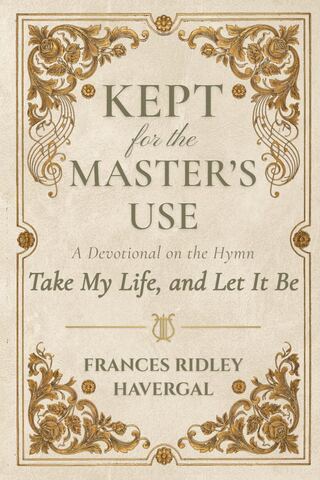
Some years later she undertook to write out the full meaning of that covenant in prose. The result was Kept for the Master's Use — a short devotional book, one chapter for each couplet of the hymn, addressed directly to the reader in Frances's characteristic style: intimate, searching, warm, and full of Scripture.
She did not live to see it widely circulated. She corrected the last proofs a few weeks before her death.
A Life of Giving and Correspondence
Frances Havergal never married, never held any office, and spent much of her adult life in the company of a small family circle or in the quiet of her own rooms. Yet her influence spread far beyond her visible world, chiefly through two channels: her poetry and hymns, and her remarkable correspondence.
She answered every letter she received — and those letters came in their hundreds, from every kind of person: the bereaved, the doubtful, the newly converted, the chronically ill. Each was answered with care, with the direct application of Scripture, and with a warmth that made the recipient feel individually known.
She gave, too, with a freedom that was sometimes startling to those around her. Her jewelry, her books, her money — she held nothing tightly. She once wrote to a friend that she had been thinking about what it meant to give every possession to Christ, and that the more she thought about it, the more she found there was nothing she could not willingly part with. Those who knew her in daily life bore witness that this expressed a genuine interior liberty.
The Final Days
In the spring of 1879, returning from a visit to friends in Ireland, Frances caught a severe chill that rapidly developed into peritonitis from which she did not recover. She was forty-two years old.
The weeks of her final illness were, by all accounts of those present, not a time of struggle but of extraordinary peace. She spoke little, but what she said was all of Christ — His nearness, His sufficiency, His welcome.
A few days before the end, when a friend read to her from the first chapter of the first epistle of John — "the blood of Jesus Christ his Son cleanseth us from all sin" — she looked up and said simply: "Wonderful."
On the morning of June 3, 1879, with her hand held by her sister Maria, she passed quietly away. She had asked, not long before, that if she died her friends would not grieve as those without hope. She wanted them to think of her as kept — kept for the Master's use, and then brought home.
Read the Devotional She Wrote as a Covenant
Kept for the Master's Use — Havergal's own prose unpacking of "Take My Life and Let It Be," completed just weeks before her death. One chapter for each couplet of consecration.