

Ask what the Puritans taught about family and the answers often arrive as slogans: the father as household governor, the home as a “little church,” the wife as subordinate, the children as catechized. Every phrase touches something real. None is enough.
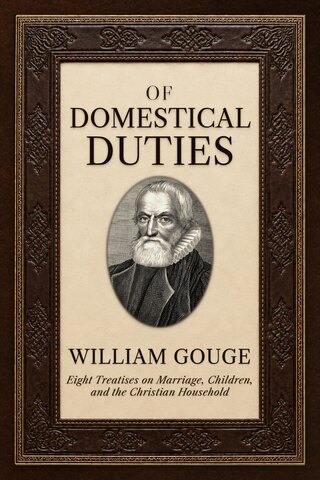
The fullest way into the subject is Of Domestical Duties, first published in 1622 by the London pastor William Gouge. At more than 280,000 words, it is not a list of maxims. It is a sustained attempt to ask what Scripture requires from each person in every ordinary household relation.
The Household Was Larger Than the Nuclear Family
For Gouge, “family” meant more than parents and their young children. A substantial early modern household might include adult children, apprentices, hired servants, widowed relatives, and lodgers, all participating in the same economy under one roof. That is why his exposition of Ephesians 5:21–6:9 moves through husband and wife, children and parents, servants and masters.
This matters when reading him now. His final treatises address forms of service, apprenticeship, household labor, and legal dependence that do not map neatly onto a modern family or workplace. The text is most useful when its historical world is named rather than quietly replaced with ours.
A Little Church and a Little Commonwealth
Gouge's best-known sentence captures the scale of his vision:
“A family is a little church, and a little commonwealth, at least a lively representation of it … as a school wherein the first principles and grounds of government and subjection are learned.”
— William Gouge, Of Domestical Duties
“Little church” did not mean that the household replaced the gathered church or its ministers. It meant that worship, biblical instruction, prayer, discipline, care, and holy example belonged within the home. “Little commonwealth” meant that the household trained people in the habits of authority and obedience they would carry into church and civic life.
Every Relation Created Duties on Both Sides
Gouge's controlling word is not rights but duties. He treats household relations in pairs. A wife's duties cannot be detached from a husband's; a child's from a parent's; a servant's from a master's. The relation binds both parties before God.
That structure does not erase hierarchy. Gouge clearly teaches male headship in marriage, parental authority, and the authority of masters. But it does prevent authority from becoming self-justifying. The superior is not free to act by mere will. Each office is limited by God's command and directed toward the good of the person under it.
Marriage: Mutual Care Before Particular Roles
Gouge begins his treatment of marriage with duties common to husband and wife: unity, faithfulness, mutual affection, care for one another's souls and bodies, peaceable living, and help in prosperity and adversity. Only then does he turn to their particular duties.
His account of those particular duties is unapologetically patriarchal and will challenge many modern readers. Yet his treatment of husbands is equally searching within that framework. A husband must love sacrificially, dwell with knowledge, protect, provide, honor, and govern for his wife's good rather than his own ease. Gouge condemns adultery by either sex and argues that authority never licenses cruelty.
Parents: Education, Example, and Measured Correction
Puritan parenting was intellectual and spiritual before it was merely disciplinary. Parents were to instruct children in faith, fit them for a calling, guide their marriages wisely, provide for them, pray with and for them, and live as examples worthy of imitation.
Correction had a place, but Gouge surrounds it with qualifications: parents must avoid passion, distinguish childish weakness from willful rebellion, suit correction to the offense and the child, and never provoke children by injustice. Parental authority answers to the heavenly Father.
Children: More Than Silent Obedience
Children owe reverence, obedience, gratitude, and practical care. Gouge extends filial duty beyond childhood: adult children remain responsible to honor aging parents, relieve them in need, receive their counsel seriously, and preserve their good name.
At the same time, obedience is not absolute. Commands contrary to God do not bind, because all earthly authority is subordinate. That limit is crucial to Gouge's entire household scheme.
Servants and Masters: A Historical World, and Real Moral Limits
The servant-master sections are the most distant from many modern readers, yet they contain some of Gouge's sharpest social ethics. Servants must work faithfully; masters must give suitable work, teach apprentices their trade rather than exploiting them for errands, pay sufficient wages in full and on time, provide care in sickness, and allow long-serving workers to establish themselves.
He calls withheld wages a crying sin. He criticizes masters who keep servants ignorant to protect their own business. He insists that masters and servants are fellow servants before God, who shows no partiality. The institution is hierarchical; the moral account is reciprocal and divine.
Family Worship Was the Household's Common Work
Prayer and biblical instruction run through the treatises. In the 1626 second edition, Gouge made that practice concrete by adding Patterns of Prayers for the Several Members of a Family: prayers for household members keyed by marginal references to sections of the larger work.
Those prayers show what “little church” meant in practice. Doctrine was to become confession, petition, thanksgiving, and intercession in the ordinary voices of a household.
How Should We Read Gouge Today?
First, read him whole. Extracting a paragraph on submission while ignoring the long duties assigned to authority produces a distorted Gouge. So does selecting only the passages that sound modern.
Second, distinguish biblical argument from social assumption. Gouge's household included legal and economic arrangements particular to seventeenth-century England. Readers must evaluate his exegesis while understanding the world to which he first applied it.
Third, let the questions remain searching. What duties accompany authority? How does a household form character? What do parents owe children's minds and souls? What does an employer owe a dependent worker? How should worship enter daily life? Gouge's answers require discernment; his refusal to leave the questions vague remains valuable.
Read the Complete Work
Of Domestical Duties — all eight treatises, moderately modernized without paraphrase, with Gouge's family prayers for every member of the household.
 Buy the Paperback
View book details →