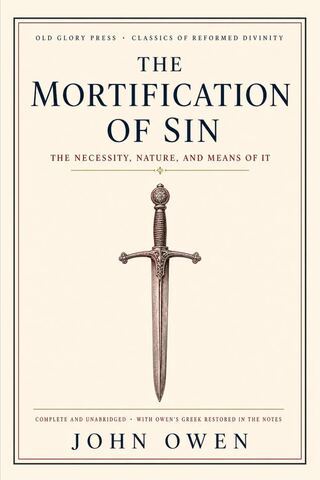

Of all the sentences the Puritans left us, one is quoted more than any other. It is only nine words long, and it comes from a book written in 1656 by a man who was, at that moment, the head of the University of Oxford:
"Be killing sin, or it will be killing you."
— John Owen, The Mortification of Sin
The book is The Mortification of Sin, and the man is John Owen. Nearly four centuries later, when Christians ask what it means to mortify sin, it is still to this small, searching treatise that they are pointed. So what did Owen mean?
The Word Itself: To Put to Death
To mortify is, quite literally, to put to death — from the Latin mortificare. It is an old word, and a violent one, and Owen chose it on purpose. The Christian's business with his sin, he insisted, is not to manage it, or tame it, or negotiate with it, but to kill it.
He took the word straight from the Apostle Paul, and the whole book is really an unfolding of a single verse:
"For if ye live after the flesh, ye shall die: but if ye through the Spirit do mortify the deeds of the body, ye shall live." (Romans 8:13)
Owen drew out of that verse the principles that shape the whole book: that this duty rests on believers; that it is the work of their whole lives; that it is done by the Spirit; and that on it hangs a great promise — "ye shall live." Hence his famous, unsettling summary: the believer is always either killing sin or being killed by it. There is no truce, no still water, no year off.
Why It Cannot Be Left Alone
Owen's first concern is to shake the reader out of complacency. Indwelling sin — the sin that remains in a Christian even after conversion — is not a spent force but a living enemy, always at work, and never more dangerous than when it seems quiet.
"Sin is never less quiet than when it seems to be most quiet, and its waters are for the most part deep when they are still."
— John Owen, The Mortification of Sin
No sin, he warns, is small enough to be left alone, and no believer is strong enough to leave it alone safely. To cease from the work of killing sin, even for a season, is not to hold ground but to lose it.
The Counterfeits Owen Exposes
Some of the most valuable pages in the book are the ones where Owen shows how easily we mistake something else for the mortification of sin. Much of what looks like victory, he argues, is only sin moved from one room of the heart to another. A man may:
- Merely divert a sin — trading a coarse vice for a respectable one, so that pride wears the clothes of self-discipline.
- Feel a temptation fade with age or circumstance, and mistake the cooling of nature for the killing of sin.
- Restrain a sin outwardly from fear of consequences or shame, while the love of it burns on inside.
- Win an occasional battle after a fright — a season of conscience after being scared — and take that for the war.
None of these, Owen says, touches the root. A sin can be suppressed, disguised, or displaced and still be entirely alive. True mortification goes deeper — it weakens sin at its source and habitually contends against it.
The One Power That Kills Sin
If Owen were only a stern moralist, the book would crush its reader. But his great point is the opposite of self-help. Sin cannot be killed by willpower, by resolutions, by rules, or by religious severity — all of which he takes apart. Paul's verse is exact: "if ye through the Spirit do mortify."
Mortification, for Owen, is the work of the Holy Spirit, taking the things of Christ and applying them to the believing heart. The Christian is not passive — he is commanded to do the killing — but he does it in a borrowed strength, by faith, looking to the cross and to the living Christ for the power he does not have in himself. The duty is ours; the power is the Spirit's. That is the hinge of the whole book, and the reason it has fed rather than flattened its readers for so long.
Why the Edition You Read Matters
Because The Mortification of Sin is a perennial bestseller, the real question a reader faces is not whether to read it but which edition to hold. And here the choices differ more than most people realize. The best-selling paperback edition is abridged — Owen's text has been shortened. Many of the cheap reprints modernize him so heavily that his voice, with its hath and doth and its long, muscular sentences, is flattened into something Owen would not recognize.
The Old Glory Press edition was made on a different principle. It is complete and unabridged — every one of the fourteen chapters and Owen's own preface to the reader — lightly modernized in spelling only, so his cadence is left intact. It is set from the 1668 third edition (printed by Nathanael Ponder, John Bunyan's own publisher) and collated against the original page images, with a transparent Note on the Text. Owen's Greek is kept in the footnotes with transliteration and sense, so his learning is preserved without checking the reader. And it opens with a warm, unhurried introduction that sets the man and his book in place before handing you straight to Owen's own words.
It is, in short, the Mortification of Sin as it should be read: the whole of it, in the author's own voice, in a book made to keep.
Read the Book Behind the Maxim
The Mortification of Sin by John Owen — the Puritan classic on putting sin to death by the Spirit. Complete and unabridged, with Owen's Greek restored in the notes. Newly typeset by Old Glory Press.