
He was silenced by a bishop, driven into exile across the sea, and drawn home into the fiercest religious quarrels his nation had ever known. He sat in an assembly of learned men who argued for years about how the church should be governed, and he stood among the minority who lost that argument. And yet the man remembered for all this strife is remembered, above everything, for a book about a quiet heart.
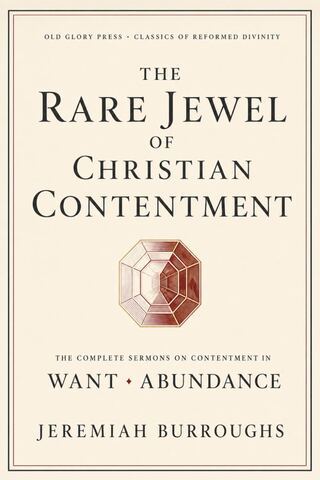
His name was Jeremiah Burroughs, and the little volume drawn from his sermons — The Rare Jewel of Christian Contentment — has outlived every controversy he was ever caught up in.
A Cambridge Puritan
Burroughs was born in 1600 and educated at Emmanuel College, Cambridge — the great nursery of Puritan ministers, where a generation of preachers was formed in the affectionate, experiential, conscience-searching divinity that would fill his own sermons. He took his degree and entered the ministry in the Church of England, serving in Norfolk, where he became an assistant and then held the living of Tivetshall.
But these were years in which a plain Puritan preacher could not long keep his pulpit in peace. Under Archbishop Laud, conformity to the ceremonies and government of the established church was pressed hard, and ministers who scrupled at them were hunted out of their charges.
Silenced, and Sent into Exile
Around 1636 the new Bishop of Norwich, Matthew Wren, moved vigorously against the nonconforming clergy of his diocese. Burroughs was deprived of his living and silenced. For a Puritan minister the loss was not merely of income but of vocation — the one thing he most wanted to do, to preach, was forbidden him.
Like many of his brethren, he crossed to the Netherlands, where the English churches of exiles offered a refuge. At Rotterdam he joined the congregation gathered there and served as its teacher alongside the pastor William Bridge. It was in these exile congregations that Burroughs and others came to embrace the Congregational (or Independent) way of ordering a church — a conviction that would shape the rest of his public life.
"That sweet, inward, quiet, gracious frame of spirit, freely submitting to, and taking complacency in God's wise and fatherly disposal in every condition."
— Jeremiah Burroughs, defining contentment
The Morning Star of Stepney
When the Long Parliament met in 1640 and the pressure on Puritan ministers eased, Burroughs returned to England. London opened its pulpits to him, and he was soon preaching to two of the largest congregations in the whole of England — at Stepney and at Cripplegate.
At Stepney he shared the labor with William Greenhill: Burroughs preached the early sermon and Greenhill the later, and admiring hearers called the two men the "morning star" and the "evening star" of Stepney. It was to these ordinary London congregations, in a city bracing for civil war, that Burroughs preached the sermons on Philippians 4 that would become The Rare Jewel of Christian Contentment.
A Dissenting Brother — and a Peacemaker
In 1643 Parliament called the Westminster Assembly to reform the worship and government of the Church of England, and Burroughs was named a member. There he became one of the five "Dissenting Brethren" — with Thomas Goodwin, Philip Nye, William Bridge, and Sidrach Simpson — who argued the Congregational case for church government against the Presbyterian majority. In 1644 the five set out their position in the famous Apologetical Narration.
Burroughs held his convictions firmly, but he held them without bitterness. Almost every contemporary who wrote of him remarked on his gentleness. Over the door of his study he is said to have set a Latin motto to the effect that variety of opinion and unity among those who hold the opinions are not incompatible — a whole philosophy of Christian peace in a single line. In 1646 he published his Irenicum, a plea to the "lovers of truth and peace" to heal the church's divisions rather than widen them.
The Books That Outlived Him
Burroughs died in 1646, at only forty-six years old, from injuries after a fall from his horse. He was mourned, in the words of one contemporary, as "a man much lamented." He had published relatively little in his lifetime; the great body of his work was drawn from his sermons and issued after his death by a circle of fellow Independent divines — Thomas Goodwin, William Greenhill, Sydrach Simpson, Philip Nye, William Bridge, and others — who prepared his manuscripts for the press.
Chief among them:
- The Rare Jewel of Christian Contentment (1648) — his sermons on Philippians 4:11, and by far his best-loved book. It was published as the first volume of the posthumous series.
- Gospel Worship and Gospel Conversation — on the worship and walk of the Christian.
- The Evil of Evils — a searching treatment of the sinfulness of sin.
- Moses' Self-Denial and A Treatise of Earthly-Mindedness — on self-denial and the heavenly mind.
- A large Exposition of the Prophecy of Hosea — his major work of biblical commentary.
Three and a half centuries later, it is the smallest of these — the sermons on a contented heart — that is still most widely read, reprinted, and loved. In it the quarrels of Burroughs' age have long since faded, and what remains is a pastor teaching his people the holy art of resting in God.
Read Burroughs' Best-Loved Book
The Rare Jewel of Christian Contentment — the classic Puritan sermons on the contented heart, complete and unabridged, with Burroughs' companion sermons on contentment in abundance and a sermon in no modern edition. Newly typeset by Old Glory Press.