The Complete Sermons on Contentment in Want and in Abundance — Jeremiah Burroughs

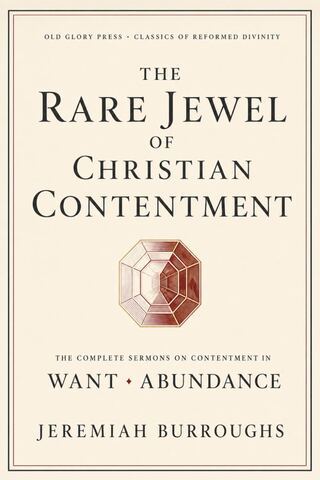
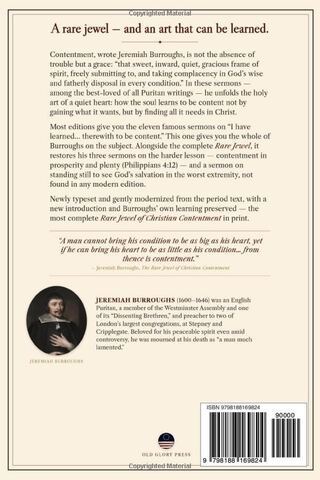
Sermons first published 1648 · Complete in two parts, with appendix · Paperback & Kindle
We spend our lives trying to change our circumstances. Jeremiah Burroughs teaches the rarer art: a heart so at rest in God that it is content in any circumstance at all.
First preached in the parish churches of Civil-War London and published in 1648, The Rare Jewel of Christian Contentment is the classic Puritan treatment of a grace most Christians long for and few possess. In eleven unhurried sermons on the Apostle's words — "I have learned, in whatsoever state I am, therewith to be content" (Philippians 4:11) — Burroughs opens what he calls the holy art and mystery of contentment: not a stoic hardness, not a change of circumstances, but "that sweet, inward, quiet, gracious frame of spirit" that freely submits to God's wise and fatherly disposal in every condition.
Nearly four centuries on, it remains one of the most beloved of all Puritan books — and this edition gives the reader more of it than any other in print. Most editions give you only the eleven sermons on being content in want. This one restores Burroughs' own sequel on the harder lesson — being content in abundance — and a sermon found in no modern edition.
"A man cannot bring his condition to be as big as his heart, yet if he can bring his heart to be as little as his condition… from thence is contentment."
— Jeremiah Burroughs, The Rare Jewel of Christian Contentment
About the Author

Jeremiah Burroughs · 1600–1646
Jeremiah Burroughs (1600–1646) was an English Puritan and one of the most beloved preachers of his generation. A member of the Westminster Assembly, he stood among its five "Dissenting Brethren," who argued for a congregational way of church government — yet he was so gentle in controversy that a fellow minister wished all disputes could be handled "with the spirit of Mr. Burroughs."
Preacher to two of London's largest congregations, at Stepney and Cripplegate, he died in 1646 at only forty-six, after a fall from his horse — mourned, in the words of one contemporary, as "a man much lamented." Most of his best-known works, including The Rare Jewel of Christian Contentment, The Evil of Evils, and Gospel Worship, were published after his death from the sermons he had preached.
Read the full biography of Jeremiah Burroughs →The Rare Jewel of Christian Contentment is a series of eleven Puritan sermons by Jeremiah Burroughs on Philippians 4:11 — "I have learned, in whatsoever state I am, therewith to be content." Burroughs describes contentment as a grace, not the absence of trouble: "that sweet, inward, quiet, gracious frame of spirit, freely submitting to, and taking complacency in God's wise and fatherly disposal in every condition." He unfolds what contentment is, the mystery and art of learning it, its excellency, the evils of a murmuring heart, and practical directions for attaining it.
Jeremiah Burroughs (1600–1646) was an English Puritan preacher and a member of the Westminster Assembly, where he was one of the five "Dissenting Brethren." He preached to two of London's largest congregations, at Stepney and Cripplegate, and was known for his peaceable spirit even amid the controversies of the Civil-War years. His sermons on contentment, published after his early death, became one of the best-loved of all Puritan books.
Most editions give you the eleven famous sermons on contentment in want. This one gives you the whole of Burroughs on contentment. Alongside the complete Rare Jewel, it restores his three companion sermons on the harder lesson — contentment in abundance and prosperity (Philippians 4:12) — printed as he preached them, and a sermon on Exodus 14:13 that appears in no modern edition. The text is established from the 1649 edition and collated against period facsimiles, gently modernized in spelling while keeping Burroughs' own voice, and freshly typeset — not a scanned facsimile.
After finishing his sermons on being content in want, Burroughs preached a direct sequel at Stepney on the very next verse, Philippians 4:12 — "I know both how to be abased, and I know how to abound." There he treats the rarer and harder lesson: how to keep a contented, God-fearing heart in prosperity and plenty, guarding against "the trouble that is in a prosperous condition." These three sermons form Part Two of this edition — a countercultural word most modern readers have never encountered.