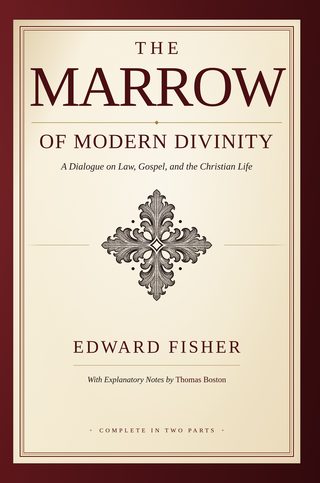
A Dialogue on Law, Gospel, and the Christian Life — Edward Fisher, with the Complete Notes of Thomas Boston

Originally published 1645 · Complete in two parts · Paperback & Kindle
Three hundred years ago, one old book so alarmed the Church of Scotland that its General Assembly forbade ministers to recommend it. This is that book.
First published in 1645, The Marrow of Modern Divinity is Edward Fisher's classic dialogue on the question at the very heart of the Christian life: how do the law and the gospel stand together? Four men take up the debate — Evangelista, a wise minister of the gospel; Nomista, a legalist; Antinomista, an antinomian; and Neophytus, a young Christian — and through their conversation Fisher charts the narrow way between trusting the law for salvation and casting it off altogether.
Rescued from obscurity by the Scottish pastor Thomas Boston, who found a worn copy in a parishioner's cottage, the book became the storm-center of the famous Marrow Controversy (1718–1723), in which Boston and the brothers Ebenezer and Ralph Erskine defended the free offer of the gospel against the charge of antinomianism. Boston's own explanatory notes — printed here in full — turned Fisher's dialogue into a landmark of Reformed teaching on grace, faith, and assurance.
This Old Glory Press edition restores the book readers actually want: not a bare reprint of Fisher, but the historically important form of the text, with Boston's complete notes and the full account of the Controversy — freshly typeset for a new generation of readers, pastors, and students.
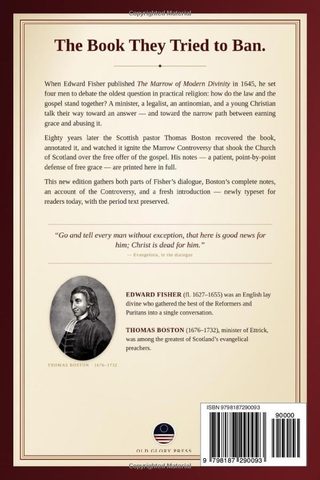
"Go and tell every man without exception, that here is good news for him; Christ is dead for him."
— Evangelista, in the dialogue
About the Authors

Thomas Boston · 1676–1732
Edward Fisher (fl. 1627–1655) was an English lay divine — a well-read layman rather than an ordained clergyman — who gathered the best of the Reformers and Puritans into a single, unforgettable conversation. His dialogue, published under the initials "E.F.," distilled a generation of Reformation teaching on law and grace into a form ordinary readers could follow.
Thomas Boston (1676–1732), minister of Ettrick, was among the greatest of Scotland's evangelical preachers and the author of Human Nature in its Fourfold State. As a young pastor he discovered a worn copy of Fisher's Marrow in a parishioner's cottage, and it shaped his ministry ever after. His explanatory notes — a patient, point-by-point defense of free grace — turned the dialogue into a Reformed landmark and set him at the center of the Marrow Controversy.
Read the full biography of Thomas Boston →The Marrow of Modern Divinity is a dialogue, first published in 1645, on how the law and the gospel relate in the Christian life. Four speakers — Evangelista, a gospel minister; Nomista, a legalist; Antinomista, an antinomian; and Neophytus, a young Christian — debate the narrow way between trusting the law for salvation and casting it off altogether. Part One treats the covenants of works and grace; Part Two expounds the Ten Commandments as the believer's rule of life.
The dialogue was compiled by Edward Fisher (fl. 1627–1655), an English lay divine who gathered the teaching of the Reformers and Puritans into a single conversation. The explanatory notes were added by Thomas Boston (1676–1732), minister of Ettrick and one of the greatest of Scotland's evangelical preachers, whose annotations made the book a landmark of Reformed teaching on grace, faith, and assurance.
The Marrow Controversy (roughly 1718–1723) was a dispute in the Church of Scotland that broke out after the book was republished in 1718. In 1720 the General Assembly condemned it and forbade ministers to recommend it, reading it as antinomian. Twelve ministers — the "Marrow Men," including Thomas Boston and the brothers Ebenezer and Ralph Erskine — defended it as a faithful statement of the free offer of the gospel.
This edition presents both parts of Fisher's dialogue together with the complete explanatory notes of Thomas Boston, set clearly as footnotes; a new introduction to the book, its authors, and the Controversy; and the appended account of the Marrow Men. It is freshly typeset in a classic Garamond for comfortable reading — not a scanned facsimile — with the original period text and King James Scripture preserved.