
He spent his life in two of the smallest and most obscure parishes in Scotland. He buried most of his children in infancy and watched his wife sink into a long affliction of body and mind. He never held high office, never preached to great crowds in his lifetime, and lay dying while he delivered his last sermons from a window of the manse to the people gathered below.
And yet the books he wrote in that quiet corner of the Border hills would be read in Scottish and American homes for two centuries — and one old volume he stumbled upon in a parishioner's cottage would set the whole Church of Scotland arguing over the free offer of the gospel.
His name was Thomas Boston.
A Covenanter's Son
Thomas Boston was born on March 17, 1676, at Duns in Berwickshire, the youngest of the family of John Boston and Alison Trotter. It was a hard time to be a devout Presbyterian in Scotland. These were the "killing times," when the government pressed conformity to the established episcopacy and those who dissented met in the fields at their peril. Boston's father was among the nonconformists who suffered for conscience, and by his own later account, the boy Thomas kept his imprisoned father company in his cell.
That early acquaintance with suffering for the gospel left its mark. Boston grew up serious, studious, and tender of conscience, formed by a household in which faith was not a matter of social convention but of costly conviction.
Converted Under Henry Erskine
The decisive turn came when Thomas was about eleven years old. His father took him to hear Henry Erskine — the father of Ebenezer and Ralph Erskine, who would one day stand with Boston in the Marrow Controversy — preach at a meeting near Newcastle. Boston records that two sermons, on the texts "Behold the Lamb of God, which taketh away the sin of the world" and "O generation of vipers, who hath warned you to flee from the wrath to come?" awakened his soul. From that season he dated the beginning of a settled work of grace in his heart.
He studied at the University of Edinburgh, taking his degree in 1694, and supported himself for several lean years by teaching school and tutoring while he pursued his theological studies and waited on a call to the ministry. He was licensed to preach by the Presbytery of Duns and Chirnside in 1697.
The Minister of Simprin — and a Book in a Cottage
In 1699 Boston was ordained to his first charge: Simprin, a parish so small it contained fewer than a hundred examinable persons. He threw himself into the labor of catechizing and preaching to his handful of people, and it was here, around the year 1700, that the event occurred for which he is most remembered by readers today.
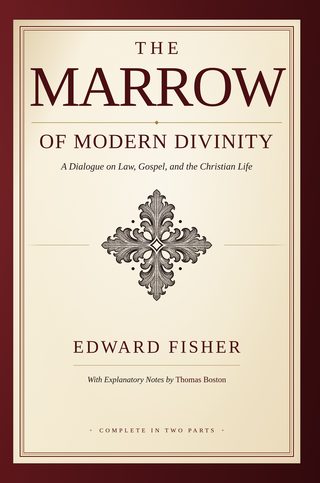
In the house of one of his parishioners, Boston came upon a small, worn volume: The Marrow of Modern Divinity, a dialogue on law and gospel first published in England in 1645 under the initials "E.F." He borrowed it, read it, and found in it a clarity on the relation of law and grace, and on the free offer of the gospel, that he felt he had been reaching after for years. In his own words, it was to him "like a light to the eyes."
The book confirmed and sharpened the note that would ring through the rest of his ministry: that the gospel is to be offered freely and without exception to sinners as sinners, and that the believer, freed from the law as a covenant of works, is still bound to it as a rule of life. That single discovery in a country cottage would, two decades later, ignite a national controversy.
"Whatsoever crook there is in one's lot, it is of God's making."
— Thomas Boston, The Crook in the Lot
Ettrick, and a Life Acquainted with Grief
In 1707 Boston was translated to the parish of Ettrick, in the Selkirkshire hills, where he would remain until his death twenty-five years later. The parish was rough and, at first, unresponsive; he labored long before he saw much fruit.
His domestic life was a school of affliction. He had married Catharine Brown in 1700; of their ten children, most died young, and Boston knew the graveside better than most fathers. In her later years Catharine was overtaken by a long and heavy distress of mind, and Boston cared for her through it with patient tenderness. Out of this furnace came one of his most beloved books, The Crook in the Lot — a meditation on the truth that the trials God bends into a believer's life are of His own making, and are not to be straightened by our own hands but submitted to His.
The Books That Outlived Him
Boston was a diligent writer, and his works became fixtures in the Reformed and evangelical world long after his death. Chief among them:
- Human Nature in its Fourfold State (1720) — his most famous book, tracing humanity through the states of innocence, nature, grace, and glory. It became one of the most widely read volumes in Scottish farmhouses for generations.
- The Crook in the Lot — on the providence of God in affliction.
- A View of the Covenant of Grace — his mature covenant theology.
- His Memoirs (A General Account of My Life) — a candid spiritual autobiography.
- The explanatory notes on The Marrow of Modern Divinity (1726) — the annotations that made the dialogue a Reformed landmark.
The great evangelist George Whitefield warmly commended Human Nature in its Fourfold State, and Boston's writings carried the Marrow theology into the Evangelical Revival on both sides of the Atlantic.
The Marrow Man
At the General Assembly of 1717, in conversation about a doctrinal case, Boston mentioned to a fellow minister the good he had received from The Marrow of Modern Divinity. The remark set others searching for the book, and in 1718 it was republished with a preface by James Hog of Carnock.
The reissue alarmed the Church's leadership. In 1720 the General Assembly condemned the Marrow and forbade ministers to recommend it, reading it as teaching antinomianism and universal atonement. Boston and eleven others — the "Marrow Men", among them Ebenezer and Ralph Erskine — protested the act and defended the book as a faithful statement of free grace. Boston had a leading hand in the ministers' formal answers to the Assembly's Queries, and in 1726 he published his own annotated edition of the Marrow, footnoting it point by point to show its orthodoxy. It is that edition — Fisher's dialogue with Boston's notes — that readers still reach for today.
The Final Days at Ettrick
Boston's health, never strong, failed in the spring of 1732. Too weak to stand in the pulpit, he is famously said to have preached his last sermons to his Ettrick people from the window of the manse, the congregation gathered outside to hear their dying pastor while breath remained to him.
He died on May 20, 1732, at the age of fifty-six, and was buried in the churchyard at Ettrick. He had spent his whole ministry in two small parishes on the edge of the map — and left behind a body of writing, and a recovered old book, that would shape Reformed Christianity for generations.
Read the Book Boston Recovered
The Marrow of Modern Divinity — Edward Fisher's classic dialogue on law and gospel, complete in two parts, with the complete explanatory notes of Thomas Boston and an account of the Marrow Controversy.