
In 1720 the highest court of the Church of Scotland did something remarkable. It took an old, obscure devotional book — first printed in London seventy-five years earlier, written by a layman whose full name almost no one knew — and it condemned the thing. Ministers were forbidden to recommend it. They were told to warn their people against it.
The book was The Marrow of Modern Divinity. The uproar that followed is remembered as the Marrow Controversy, and for a few years in the 1720s it turned Scotland's ministers against one another over a single, searching question: is the gospel really free?
The Book at the Center
First published in 1645 under the initials "E.F." — generally identified as the English lay divine Edward Fisher — The Marrow of Modern Divinity is a dialogue. Four men sit down to talk: Evangelista, a wise minister of the gospel; Nomista, a legalist who leans on the law; Antinomista, an antinomian who would throw the law away; and Neophytus, a young Christian trying to find his footing. Through their conversation Fisher maps the narrow path between two ditches — earning grace by law-keeping on the one side, and abusing grace as a license to sin on the other.
Its central note is the freeness of the gospel: that Christ and His salvation are to be offered to every sinner, without exception and without precondition. As Evangelista puts it in one of the book's most famous lines:
"Go and tell every man without exception, that here is good news for him; Christ is dead for him."
— Evangelista, in the dialogue
It was that sentence, and others like it, that would later be read by some as dangerous — and defended by others as the very heart of the gospel.
A Book Recovered in a Cottage
Around the year 1700, a young minister named Thomas Boston found a worn copy of the Marrow in the home of one of his parishioners at Simprin. Reading it clarified for him the relation of law and gospel he had long been reaching after. He never forgot it.
Years later, at the General Assembly of 1717, Boston mentioned the book to a fellow minister. The recommendation spread, and in 1718 the Marrow was reprinted in Scotland with a commendatory preface by James Hog of Carnock. An old English book was suddenly circulating again — and this time it landed in the middle of a Church already nervous about the boundaries of grace.
The Spark: the Auchterarder Creed
The tinder had been laid the year before. In 1717 the Assembly had taken up a case from the Presbytery of Auchterarder, which had asked a ministerial candidate to affirm a strongly worded proposition:
"It is not sound and orthodox to teach that we must forsake sin in order to our coming to Christ."
The proposition — later nicknamed the "Auchterarder Creed" — was clumsily phrased, but it was trying to guard a real truth: that a sinner does not first clean himself up and then come to Christ, but comes to Christ as he is. The Assembly condemned the statement as unsound. To men like Boston, that condemnation looked like an attack on free grace itself — and the republished Marrow, which taught the same instinct far more carefully, suddenly seemed urgently relevant.
The Condemnation of 1720
In 1720 the General Assembly acted against the book directly. It passed an Act condemning The Marrow of Modern Divinity, prohibiting ministers from recommending it and instructing them to warn their congregations against it. The Assembly's committee had combed the book and drawn from it a list of alleged errors — among them that assurance belongs to the essence of faith, that it taught a kind of universal atonement (the "Christ is dead for you" language), that holiness was made less than necessary, that the fear of punishment and hope of reward were disallowed as motives, and that the believer was freed from the law even as a rule of life.
The Marrow's defenders answered that the Assembly had misread Fisher at every point — that his "Christ is dead for you" was the warrant of the free offer, not a claim of universal redemption; that he distinguished the law as a covenant from the law as a rule; and that he honored holiness as the fruit of faith, not its price.
The Marrow Men
Twelve ministers refused to let the condemnation stand unanswered. Known ever after as the Marrow Men (or Marrow Brethren), they included Thomas Boston, the brothers Ebenezer and Ralph Erskine, James Hog, and Gabriel Wilson. In 1721 they submitted a Representation to the Assembly, protesting the Act and asking for it to be reconsidered.
The Assembly's Commission responded not by reconsidering, but by putting to the twelve a set of twelve pointed Queries — probing their views on assurance, the extent of the atonement, the believer and the law, and the motives of obedience. The Marrow Men returned careful, closely argued Answers to the Queries in 1722, a document in which Boston's hand is especially evident. It remains one of the clearest statements of the Reformed doctrine of the free offer ever produced under fire.
In the end the Assembly of 1722 reaffirmed its condemnation and formally rebuked and admonished the twelve — but it did not depose them. They kept their pulpits, and they kept preaching the free grace they had defended.
Boston's Answer: the Annotated Marrow
Thomas Boston gave the controversy its most lasting legacy. In 1726 he published an edition of The Marrow of Modern Divinity furnished with his own explanatory notes — footnoting Fisher's dialogue point by point to show its harmony with Scripture and the Reformed confessions. Boston's notes did not merely defend the book; they deepened it, turning a lively dialogue into a landmark of Reformed teaching on grace, faith, and assurance. It is that edition — Fisher's dialogue with Boston's notes — that readers still reach for today.
Why It Still Matters
The Marrow Controversy was never really about a single old book. It was about whether the gospel can be preached freely to all — whether a minister may look any sinner in the eye and say, without qualification, that there is good news for him. The Marrow Men insisted that he can and must, and their stand helped keep the free offer of the gospel at the center of Scottish preaching.
The theology they defended — the sharp distinction between law and gospel, the freeness of grace, the difference between serving God as a hired hand and as a beloved child — flowed on into the Evangelical Revival and, through Ebenezer Erskine and others, into the Secession Church of 1733. Three centuries later, wherever Christians argue about law and grace, legalism and license, the questions the four men debated in Fisher's dialogue are still very much alive.
Read the Book at the Heart of the Controversy
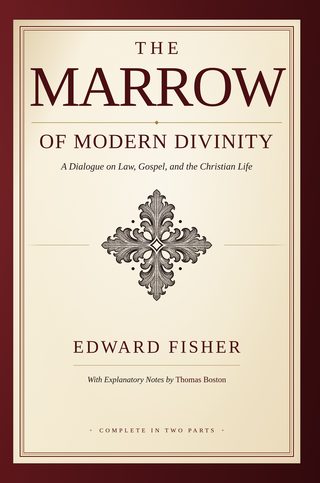
The Marrow of Modern Divinity — Edward Fisher's classic dialogue, complete in two parts, with the complete explanatory notes of Thomas Boston and an account of the Marrow Controversy. Newly typeset by Old Glory Press.