
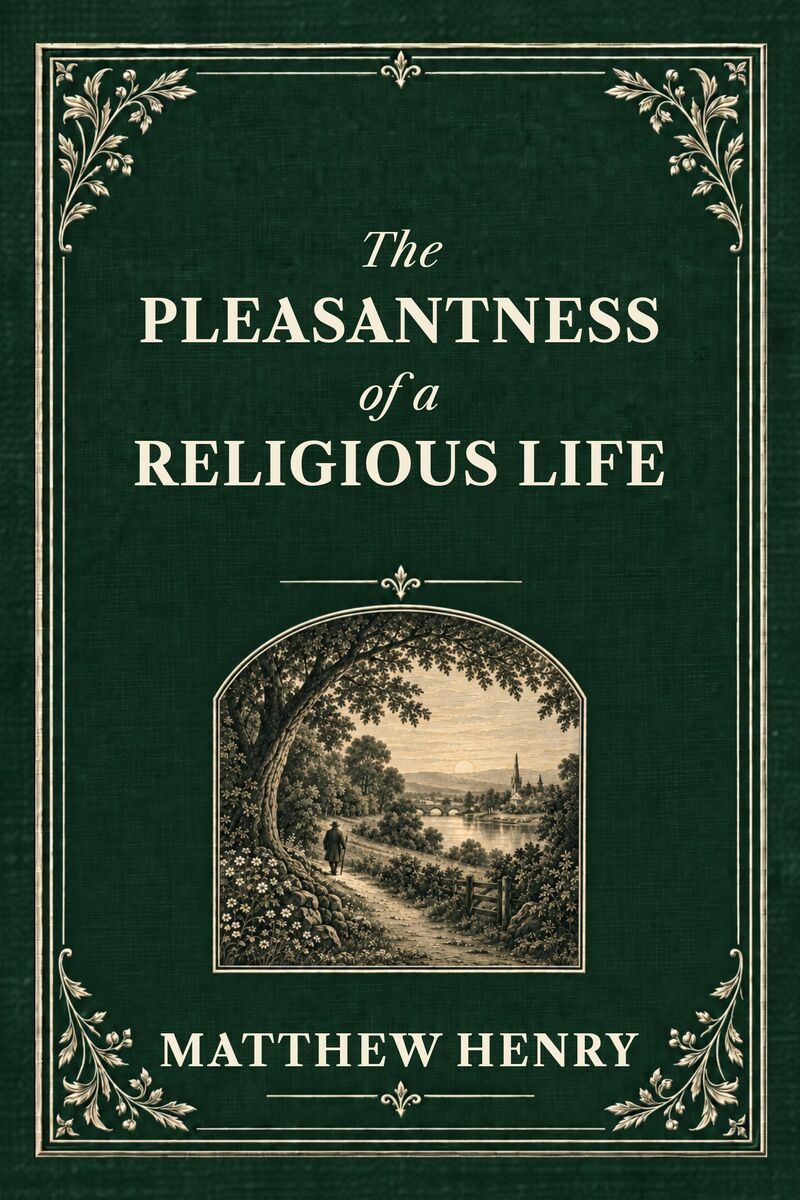
Some descriptions of Christianity begin with necessity: what we must believe, refuse, endure, and do. Matthew Henry does not dispute any of that. But in The Pleasantness of a Religious Life, he asks readers to see something necessity alone cannot express. The ways of God are not merely obligatory. They are good for those who walk in them.
His governing text is Proverbs 3:17: “Her ways are ways of pleasantness, and all her paths are peace.” The “her” is wisdom. Henry unfolds the verse into a sustained answer to an old suspicion—that serious religion must diminish human happiness. His answer is neither breezy optimism nor a promise that believers will avoid grief. It is a richer account of what people are made to enjoy and where durable peace can be found.
It Asks the Right Question About Pleasure
Henry does not ask whether human beings desire pleasure. He assumes they do. The question is whether our pleasures answer the design of the soul or leave it restless. Appetite and favorable circumstances can supply real enjoyments, but they cannot carry the full weight of human hope. A life governed by them remains vulnerable to every change outside us and every unruly desire within.
Religious life, in Henry’s argument, does not destroy desire. Grace reorders it. Communion with God becomes a good rather than a burden; ordinary mercies are received as gifts; and the soul is freed from asking temporary things to provide final satisfaction. This is why the book speaks helpfully to modern readers surrounded by comforts yet practiced in discontent. Henry directs attention beyond the next acquisition or improved circumstance to the kind of person capable of receiving good things rightly.
It Is Honest About the Cost of Discipleship
A shallow case for Christian happiness would collapse as soon as suffering arrived. Henry anticipates that problem. He considers repentance, self-denial, difficult duties, spiritual conflict, affliction, heaviness, and death. These are not footnotes to his case; they are tests of it.
His claim is therefore more careful than “Christians always feel cheerful.” Sorrow can be deep without possessing the whole field. Self-denial can be painful while freeing a person from a worse mastery. Duty can be hard while still belonging to a peaceful path. Affliction can remain affliction while burdens are committed to providence and grief is held within the larger promises of God.
This realism makes the title’s word pleasantness more substantial. Henry is describing neither temperament nor uninterrupted emotion. He is describing the fitness of God’s ways for human flourishing: a reconciled relationship with God, a conscience brought toward peace, desires learning their proper order, and hope able to look beyond death.
It Connects Inward Peace with Outward Usefulness
Henry’s practical divinity does not make joy private. A religious life changes how people treat one another. When desires do not rule unchecked and providence is trusted, believers become freer to love, serve, forgive, and carry ordinary responsibilities without making everyone around them answer for their discontent.
That point is especially valuable because “peace” can be mistaken for withdrawal. Henry’s peaceful path runs through worship, relationships, and duty. The pleasantness he commends is meant to become visible in cheerful obedience and practical love. Readers are invited to ask not only whether they speak well of religion, but whether their manner of life makes its goodness credible.
It Shows Henry’s Pastoral Method in Concentrated Form
Matthew Henry is best known for his expansive biblical Exposition. This shorter book offers the same characteristic movement—from text, to doctrine, to conscience—in a compact argument. According to Henry’s preface, its substance had first been preached in six sermons “in the ordinary course” of his ministry. Friends urged him to publish it.
The book retains that sermonic architecture. Henry opens his text, explains his doctrine, argues from Scripture and experience, addresses objections, and then presses application. Because the subject is sustained across the whole work, readers can follow one pastoral argument farther than a brief devotional entry allows, without undertaking a large theological volume.
How to Read It Well
Read slowly enough to test Henry’s categories against your own life. When he distinguishes passing gratification from settled peace, ask what disappointments have been carrying too much of your hope. When he joins pleasantness to duty, ask whether you treat obedience chiefly as an interruption. When he discusses sorrow, notice that comfort does not require pretending pain is small.
It also helps to keep Proverbs 3 open. Henry’s argument belongs to wisdom literature, where a “way” is a pattern and direction of life. Individual moments on that way may be severe. The question is where the path leads, what kind of traveler it forms, and whether its promised peace is trustworthy.
That is the chief reason to read The Pleasantness of a Religious Life: it gives a serious answer to a serious misconception. Christianity is not pleasant because it flatters every appetite or shields believers from tears. It is pleasant because grace restores the soul toward its proper good, gives company and comfort on a difficult road, and leads that road home.
Sources
- Matthew Henry, The Pleasantness of a Religious Life, especially “To the Reader,” “The Explication of the Doctrine,” “The Doctrine Vindicated,” and “The Application of the Doctrine.”
- Internet Archive facsimile record for the 1715 second edition.
- Oxford Dictionary of National Biography, “Henry, Matthew (1662–1714), Presbyterian minister”.
Walk Wisdom’s Pleasant Ways
The Pleasantness of a Religious Life presents Matthew Henry’s complete, Scripture-rich argument for joy and peace in the ways of God.
View book details