I’ll Take My Stand
The South and the Agrarian Tradition

First published 1930 · 257 pages · Paperback & Kindle
In 1930, twelve Southern poets, historians, and scholars made their case for the farm, the household, and the settled local life against the industrial order then remaking America. This is their book, complete.
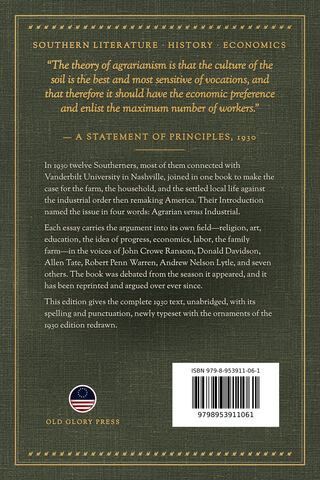
“The theory of agrarianism,” their Introduction declares, “is that the culture of the soil is the best and most sensitive of vocations, and that therefore it should have the economic preference and enlist the maximum number of workers.” Agreeing on that ground, which they summed up as “Agrarian versus Industrial,” each writer carried the argument into his own field: religion, art, education, the idea of progress, economics, labor, the family farm, and the life of a Southern gentleman.
Most of the Twelve were connected with Vanderbilt University in Nashville, and four of them, John Crowe Ransom, Donald Davidson, Allen Tate, and Robert Penn Warren, had been the Fugitive poets of the early 1920s. Their symposium was debated in the press and on the lecture platform from the season it appeared, and it has been reprinted and argued over ever since. Read more about the book and its reception.
About This Edition
- The complete 1930 text, unabridged — the dedication, the Introduction, “A Statement of Principles,” all twelve essays, and the authors’ notes
- The text of the first printing, with its spelling, punctuation, and emphasis kept and evident misprints corrected
- Newly typeset — 257 pages at 6 × 9 inches, with the sprig and cord ornaments of the 1930 edition redrawn
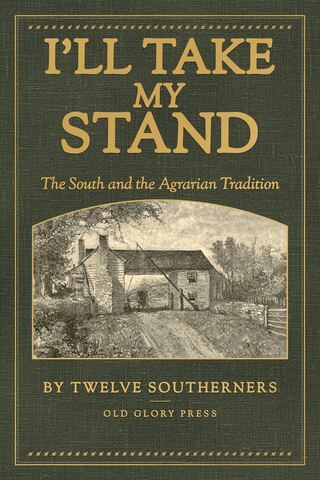
- A cover after the 1930 Harper binding of olive cloth, with an 1886 Harper’s engraving of a Kentucky farmhouse on the Harrodsburg Pike
- Paperback and Kindle, for readers in the United States
“Throw out the radio and take down the fiddle from the wall.”
— Andrew Nelson Lytle, “The Hind Tit”
Paperback · ISBN 979-8-953911-06-1
Kindle ebook
The Contributors
Twelve Southerners
The essays appear in this order, after the Introduction, “A Statement of Principles,” to which all twelve subscribed.
- John Crowe Ransom, “Reconstructed but Unregenerate”
- Donald Davidson, “A Mirror for Artists”
- Frank Lawrence Owsley, “The Irrepressible Conflict”
- John Gould Fletcher, “Education, Past and Present”
- Lyle H. Lanier, “A Critique of the Philosophy of Progress”
- Allen Tate, “Remarks on the Southern Religion”
- Herman Clarence Nixon, “Whither Southern Economy?”
- Andrew Nelson Lytle, “The Hind Tit”
- Robert Penn Warren, “The Briar Patch”
- John Donald Wade, “The Life and Death of Cousin Lucius”
- Henry Blue Kline, “William Remington: A Study in Individualism”
- Stark Young, “Not in Memoriam, but in Defense”
They were poets, historians, a psychologist, an economist, a biographer, and a drama critic. The book is dedicated to Walter L. Fleming, historian and dean of Vanderbilt’s Graduate School, “to whom some of the contributors owe doctrine and example.”
Who were the Southern Agrarians? →Questions About the Book
What is I’ll Take My Stand?
A symposium published by Harper & Brothers in 1930, “by Twelve Southerners.” An unsigned Introduction, “A Statement of Principles,” to which every contributor subscribed, sets out the ground they shared, “Agrarian versus Industrial,” and twelve essays carry the argument into religion, art, education, the idea of progress, economics, labor, the farm household, and the life of a Southern gentleman. More on the book’s argument and reception.
Who wrote it?
John Crowe Ransom, Donald Davidson, Frank Lawrence Owsley, John Gould Fletcher, Lyle H. Lanier, Allen Tate, Herman Clarence Nixon, Andrew Nelson Lytle, Robert Penn Warren, John Donald Wade, Henry Blue Kline, and Stark Young. Most were connected with Vanderbilt University in Nashville, and Ransom, Davidson, Tate, and Warren had been the Fugitive poets of the early 1920s. Read about the twelve contributors.
Is the text complete?
Yes. This edition gives the complete text of the 1930 first printing, unabridged: the dedication, the Introduction, all twelve essays, and the authors’ notes. The 1930 spelling, punctuation, and emphasis are kept, and evident misprints are corrected.
Which formats are available?
The paperback and Kindle editions are available on Amazon in the United States. The paperback is 257 pages at 6 × 9 inches, ISBN 979-8-953911-06-1.