
The title page of I’ll Take My Stand names no one. It says only “by Twelve Southerners,” and the Introduction that follows, “A Statement of Principles,” is unsigned. Of that statement the authors write: “To it every one of the contributors in this book has subscribed.” The twelve essays that follow are signed, and the men who wrote them were a varied company: poets, historians, a psychologist, an economist, a biographer, and a drama critic.
Most of them had a tie to Vanderbilt University in Nashville. By the count of the Tennessee Encyclopedia, six were current or former members of the Vanderbilt faculty (Ransom, Davidson, Lanier, Nixon, Owsley, and Wade), four were former students (Tate, Kline, Lytle, and Warren), and the remaining two, Stark Young and John Gould Fletcher, were literary acquaintances of Allen Tate. Four had belonged to the Fugitives, the Vanderbilt circle whose poetry magazine, The Fugitive, appeared from 1922 to 1925. The book is dedicated to Walter L. Fleming, the Vanderbilt historian and graduate dean, “to whom some of the contributors owe doctrine and example.”
Below, in the order of their essays, are the twelve.
John Crowe Ransom (1888–1974)
“Reconstructed but Unregenerate”
Born in Pulaski, Tennessee, the son of a Methodist minister, Ransom entered Vanderbilt at fifteen and graduated in 1909, then studied at Oxford as a Rhodes Scholar. He taught English at Vanderbilt from 1914 to 1937 and was the leading member of the Fugitives. The Tennessee Encyclopedia credits him with the Introduction, “A Statement of Principles,” as well as the book’s opening essay; his God Without Thunder appeared the same year. In 1937 he moved to Kenyon College in Ohio, where he founded and edited the Kenyon Review. His book The New Criticism (1941) gave a school of literary criticism its name. He received the Bollingen Prize in 1951 and the National Book Award for poetry in 1963, and died at Gambier, Ohio, in 1974.
Donald Davidson (1893–1968)
“A Mirror for Artists”
Davidson was born at Campbellsville, near Pulaski, Tennessee, and earned his bachelor’s and master’s degrees at Vanderbilt, where he taught English for his entire career. He was a founding member of the Fugitive circle and, with Ransom and Tate, one of the organizers of the Agrarian symposium. His long poem The Tall Men appeared in 1927; later came The Attack on Leviathan: Regionalism and Nationalism in the United States (1938) and a two-volume history of the Tennessee River. From 1931 he spent his summers teaching at the Bread Loaf School of English in Vermont. Of the group, he held most closely to the Agrarian cause in later decades.
Frank Lawrence Owsley (1890–1956)
“The Irrepressible Conflict”
Owsley was born on his grandparents’ farm near Montgomery, Alabama, and studied at the Alabama Polytechnic Institute (now Auburn) and at the University of Chicago, where he took his doctorate under William E. Dodd. He taught history at Vanderbilt from 1920 to 1949 and then helped establish the doctoral program in history at the University of Alabama. His books include a study of state rights in the Confederacy (1925), King Cotton Diplomacy (1931), and Plain Folk of the Old South (1949), which argued from archival records for the place of the small farmer in the antebellum South. He died in England in 1956, while there on a Fulbright fellowship.
John Gould Fletcher (1886–1950)
“Education, Past and Present”
Born in Little Rock, Arkansas, Fletcher left Harvard without a degree and in 1908 sailed for Europe. Settled in London by 1913, he became known as one of the Imagist poets, appearing in the Some Imagist Poets anthologies. He met Ransom, Davidson, and Tate on a visit to the United States in 1927 and was invited to contribute to the symposium. He returned to live in Arkansas in 1933, where he turned to regional subjects and organized the Arkansas Folklore Society. In 1939 he received the Pulitzer Prize for Poetry for his Selected Poems, the first Southern poet to win it. He died near Little Rock in 1950.
Lyle H. Lanier (d. 1988)
“A Critique of the Philosophy of Progress”
Lyle Hicks Lanier graduated from Vanderbilt in 1923 and took his master’s and doctoral degrees at George Peabody College in Nashville. A psychologist, he taught psychology at Vanderbilt from 1929 to 1938. His later career was in university administration: he served as executive vice president and provost of the University of Illinois and, after retiring from Illinois, as a director with the American Council on Education in Washington. He died in 1988.
Allen Tate (1899–1979)
“Remarks on the Southern Religion”
Tate was born in Winchester, Kentucky, and graduated from Vanderbilt in 1922; he was the only undergraduate admitted to the Fugitives and a founding editor of their magazine. Before the symposium he had written Stonewall Jackson: The Good Soldier (1928) and Jefferson Davis: His Rise and Fall (1929), and he is remembered for the poem “Ode to the Confederate Dead” and his novel The Fathers. He did not like the book’s title, and said so in a note to his own essay. With Herbert Agar he edited the second Agrarian symposium, Who Owns America? (1936). He served as Consultant in Poetry to the Library of Congress (1943–44), edited the Sewanee Review (1944–46), and taught at the University of Minnesota from 1951 until his retirement. He died in Nashville in 1979.
Herman Clarence Nixon (1886–1967)
“Whither Southern Economy?”
Nixon was born in Merrellton, Alabama, studied at the Alabama Polytechnic Institute and the University of Chicago, and served in the First World War. He taught history at Vanderbilt from 1925 to 1928 and political science at Tulane from 1928 to 1938, returning to Vanderbilt in 1940, where he was later a professor and editorial director of the Vanderbilt University Press. Of all the Agrarians he went furthest in pursuing practical measures against rural poverty: he supported New Deal programs such as the Tennessee Valley Authority, lobbied for the Bankhead–Jones Farm Tenancy bill, and was one of the organizers of the Southern Conference for Human Welfare.
Andrew Nelson Lytle (1902–1995)
“The Hind Tit”
Born in Murfreesboro, Tennessee, Lytle graduated from Vanderbilt in 1925 and studied at the Yale School of Drama, acting in New York before turning to history and fiction. His Bedford Forrest and His Critter Company appeared in 1931, followed by novels including The Long Night (1936) and The Velvet Horn (1957). Vanderbilt’s archivists note that he was the only Agrarian who actually supported himself by farming while he wrote. He taught at the University of the South and edited the Sewanee Review from 1961 until he retired in 1973. He died at Monteagle, Tennessee, in 1995.
Robert Penn Warren (1905–1989)
“The Briar Patch”
Warren was born in Guthrie, Kentucky, and entered Vanderbilt in 1921, where the Fugitives took him in as an undergraduate. After graduating in 1925 he studied at the University of California and at Oxford as a Rhodes Scholar; his was the last essay to reach the symposium. At Louisiana State University he and Cleanth Brooks edited the Southern Review and wrote the textbook Understanding Poetry. He is the only writer to have won Pulitzer Prizes for both fiction (All the King’s Men, 1947) and poetry (1958 and 1979), and in 1986 he was named the first Poet Laureate of the United States. He died in Vermont in 1989.
John Donald Wade (1892–1963)
“The Life and Death of Cousin Lucius”
Wade was born in Marshallville, Georgia, and studied at the University of Georgia, Harvard, and Columbia, where he completed a doctorate after service in the First World War. His biography Augustus Baldwin Longstreet (1924) was followed by a life of John Wesley, and he wrote more than a hundred sketches for the Dictionary of American Biography. He came to Vanderbilt in 1928 to direct its graduate program in American literature. According to the New Georgia Encyclopedia, it was Wade who gave the book its title; his own essay is drawn from the life of his maternal uncle. He returned to the University of Georgia in 1934, founded the Georgia Review, and died in Marshallville in 1963.
Henry Blue Kline (d. 1951)
“William Remington: A Study in Individualism”
Kline was a student of Ransom and Davidson and received his master’s degree from Vanderbilt in 1929. He taught at the University of Tennessee from 1930 to 1933 and then held government posts with the Civil Works Administration and the Tennessee Valley Authority. From 1944 to 1949 he wrote editorials for the St. Louis Post-Dispatch, and he then joined the Atomic Energy Commission, where he worked until his death in 1951.
Stark Young (1881–1963)
“Not in Memoriam, but in Defense”
Young was born in Como, Mississippi, graduated from the University of Mississippi in 1901, and took a master’s degree at Columbia. He taught English at Mississippi, Texas, and Amherst before leaving teaching in 1921 to become drama critic and an editorial board member of the New Republic, at the invitation of its editor, Herbert Croly. He wrote plays and four novels set in Mississippi, the best known being So Red the Rose (1934). His essay closes the symposium. He retired from the New Republic in 1947, later translated Chekhov, and died in New York in 1963.
After the Book
The twelve were held together, as the Tennessee Encyclopedia puts it, “by ties of mutual affection but only loosely by shared intellectual commitments,” and their paths diverged. Several joined in a second symposium, Who Owns America? (1936); Ransom, Tate, and Warren became leading critics and editors; Nixon moved toward New Deal reform; Davidson and Lytle stayed closest to the Agrarian argument. For the book that first brought them together, its argument and its reception, see What Is I’ll Take My Stand?
Sources
- I’ll Take My Stand: The South and the Agrarian Tradition, by Twelve Southerners (New York and London: Harper & Brothers, 1930): title page, dedication, Introduction, and Tate’s note to his essay.
- Vanderbilt University Special Collections, Fugitive and Agrarian Collection (MSS.0160), biographical notes; and “Nixon, Herman Clarence”; I’ll Take My Stand original manuscript (MSS.0222).
- Paul V. Murphy, “Agrarians” and “Donald Davidson”, Tennessee Encyclopedia.
- Tennessee Encyclopedia entries “John Crowe Ransom”, “Frank Lawrence Owsley”, “John Orley Allen Tate”, “Herman Clarence Nixon”, “Andrew Nelson Lytle”, and “Robert Penn Warren”.
- “Frank Lawrence Owsley,” Encyclopedia of Alabama.
- “John Gould Fletcher (1886–1950),” CALS Encyclopedia of Arkansas; University of Arkansas Libraries, John Gould Fletcher Papers.
- Library of Congress, “Allen Tate” and “Robert Penn Warren”; Poetry Foundation, “Allen Tate”.
- “Robert Penn Warren,” Encyclopædia Britannica.
- Clay Morton, “John Donald Wade,” New Georgia Encyclopedia.
- “Stark Young,” Mississippi Encyclopedia.
Read the Twelve in Their Own Words
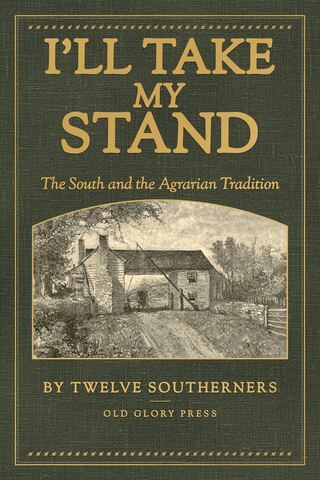
I’ll Take My Stand — the complete 1930 text, with the Introduction and all twelve essays, newly typeset by Old Glory Press.
 Buy the Paperback
View book details →