
In November 1930, a year into the Great Depression, Harper & Brothers of New York published a book of essays “by Twelve Southerners” under the title I’ll Take My Stand: The South and the Agrarian Tradition. Its contributors, most of them connected with Vanderbilt University in Nashville, set out to defend a way of life built on the farm, the household, and the settled local community against the industrial order then spreading across the country. Within days the book was being argued over before thousands of listeners, and it has been reprinted and debated ever since.
How the Book Came About
The book grew out of the circle of Vanderbilt teachers and students who had published the poetry magazine The Fugitive from 1922 to 1925. According to the Tennessee Encyclopedia, the Agrarian project was organized by John Crowe Ransom and Donald Davidson, both Vanderbilt professors and poets, and their former student Allen Tate. The Virginia Quarterly Review’s account records that as early as 1926 Ransom and Tate had agreed they “must do something about Southern history and the culture of the South,” and that Ransom drafted the “Statement of Principles,” first called “Articles of Agrarian Reform.” The twelve contributors were poets, historians, a psychologist, an economist, a biographer, and a drama critic.
The authors themselves describe the method in the Introduction. Each man wrote on “a chosen topic,” and beyond that “there was to be no further collaboration”; “no single author is responsible for any view outside his own article.” The title was not unanimous. The New Georgia Encyclopedia credits John Donald Wade with choosing it, and Allen Tate added a note to his own essay saying that “in his opinion the general title of this book is not quite true to its aims.”
The Statement of Principles
The unsigned Introduction is the book’s common creed. “To it,” the authors write, “every one of the contributors in this book has subscribed.” It opens by naming the shared ground: all the essays “tend to support a Southern way of life against what may be called the American or prevailing way,” and all agree that the distinction is best put in the phrase “Agrarian versus Industrial.”
It then defines its opponent:
“Industrialism is the economic organization of the collective American society.”
Under industrialism, the Statement argues, labor becomes hard, fast, and insecure, and is “practiced solely for its rewards”; consumption grows hurried; and “the modern man has lost his sense of vocation.” It carries the case past economics. “Religion can hardly expect to flourish in an industrial society,” because a nature turned into cities and commodities is no longer felt as mysterious. The arts suffer for want of leisure. And “the amenities of life also suffer under the curse of a strictly-business or industrial civilization”: manners, conversation, hospitality, sympathy, family life, romantic love. It calls advertising, needed because production outruns natural consumption, “the most significant development of our industrialism,” and it answers those who would cure the spiritual poverty of the age by education alone that the trouble lies at the economic base and cannot be mended “by pouring in soft materials from the top.”
Against all this it sets the agrarian alternative, which, it says, “does not stand in particular need of definition.” An agrarian society is not one without industry, professions, scholars, or cities, but one in which agriculture is the leading vocation and the model for the rest:
“The theory of agrarianism is that the culture of the soil is the best and most sensitive of vocations, and that therefore it should have the economic preference and enlist the maximum number of workers.”
The Statement is plain about its limits. “Nobody now proposes for the South, or for any other community in this country, an independent political destiny,” it says, and its authors “would be happy to be counted as members of a national agrarian movement.” It closes with a list of practical questions, from legislation to party politics to schooling, and admits: “These principles do not intend to be very specific in proposing any practical measures.”
The Twelve Essays
Each essay applies the common principles to one field. Ransom opens with “Reconstructed but Unregenerate”; Davidson writes on the arts, Owsley on the sectional conflict, Fletcher on education, Lanier on the idea of progress, Tate on religion, and Nixon on the Southern economy. Andrew Lytle’s “The Hind Tit” turns to the farm household and gives the book one of its best-known lines: “Throw out the radio and take down the fiddle from the wall.” Robert Penn Warren’s “The Briar Patch” follows; John Donald Wade and Henry Blue Kline contribute portraits in narrative form; and Stark Young closes with “Not in Memoriam, but in Defense.”
The Richmond Debate
The argument went public before the book was off the press. Stringfellow Barr, a history professor at the University of Virginia and managing editor of the Virginia Quarterly Review, had been invited to contribute but could not sign the Agrarians’ platform. His essay “Shall Slavery Come South?”, calling instead for a regulated industrialism, appeared in the October 1930 issue, the first under his editorship. Ransom, Tate, and Davidson answered with an open letter, Barr replied, and the exchange ran on the Associated Press wires until a debate was proposed.
It took place in Richmond on November 14, 1930, two days after the book’s release, under the sponsorship of the Richmond Times-Dispatch. About 3,500 people filled the City Auditorium. The novelist Sherwood Anderson introduced the speakers, remarking that Ransom “isn’t a farmer” and Barr “doesn’t manufacture anything.” Ransom read a prepared argument for nearly an hour; Barr spoke for about twenty minutes from notes. “I accept the weather,” Barr said, “and I accept industrialism,” and he closed by advising that when problems are complex one should cry not “I’ll Take My Stand” but “Sit Down and Think.” No winner was declared. Ransom later admitted he had been given a “thorough trouncing” in Richmond; he went on to further debates, including one in New Orleans with William S. Knickerbocker, editor of the Sewanee Review.
Reception
The book drew both sympathy and criticism from the start. The Tennessee Encyclopedia summarizes the critics’ charges: that the Agrarians romanticized the Old South, overlooked the region’s inequalities and the poverty of much Southern farm life, and tried in vain to roll back progress. The same source notes that the contributors were bound “by ties of mutual affection but only loosely by shared intellectual commitments,” and that they differed among themselves in tone and outlook. The Agrarians never founded the county newspaper they had discussed, and, as the Virginia Quarterly Review observes, only a handful of them ever went back to the farm.
The Sequel: Who Owns America?
In 1936 Houghton Mifflin published a second symposium, Who Owns America? A New Declaration of Independence, edited by Herbert Agar and Allen Tate. It joined several of the Agrarians with the English Distributists, who argued for widely held small property. Wade contributed “Of the Mean and Sure Estate,” and Ransom, in his essay, conceded that the South must accept industrialization to preserve its economic autonomy. By 1940 Ransom had called the agrarian ideal a “fantasy” in the Kenyon Review, though he did not recant the humane values he had defended.
Later Readers
The book has stayed in print and in argument. Harper reissued it as a Torchbook in 1962, and Louisiana State University Press has published it since the 1970s, including a seventy-fifth-anniversary edition in its Library of Southern Civilization series in 2006. Several of the Twelve went on to shape American letters: Ransom’s The New Criticism (1941) named a school of criticism, and Warren and Cleanth Brooks’s Understanding Poetry changed how literature was taught in American colleges. Davidson’s later writing influenced postwar thinkers such as Richard M. Weaver and M. E. Bradford, and the Tennessee Encyclopedia notes that the book survived both as “a much-studied literary episode” and as a source for Southern conservatives.
Whatever a reader makes of its arguments, I’ll Take My Stand remains a primary document of American thought between the wars, and it is best judged in its own words, complete.
Sources
- I’ll Take My Stand: The South and the Agrarian Tradition, by Twelve Southerners (New York and London: Harper & Brothers, 1930): Introduction, “A Statement of Principles”; Tate’s note to “Remarks on the Southern Religion”; Lytle, “The Hind Tit.”
- Paul V. Murphy, “Agrarians,” Tennessee Encyclopedia; “John Crowe Ransom,” Tennessee Encyclopedia.
- “The Richmond Debate of 1930,” Virginia Quarterly Review (2011).
- Clay Morton, “John Donald Wade,” New Georgia Encyclopedia.
- “John Crowe Ransom, 1888–1974,” Documenting the American South, University of North Carolina.
- “They Took Their Stand: The Emergence of the Southern Agrarians,” Prospects (Cambridge University Press), for the publication date and the 1962 Torchbook reissue.
- WorldCat record, Who Owns America? (Houghton Mifflin, 1936).
- LSU Press, I’ll Take My Stand, Library of Southern Civilization (2006).
Read the Book Complete
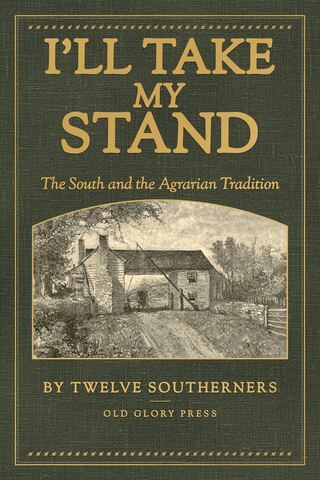
I’ll Take My Stand — the complete 1930 text, with the Statement of Principles and all twelve essays, newly typeset by Old Glory Press.
 Buy the Paperback
View book details →