
The short answer: Frances Ridley Havergal wrote "Take My Life and Let It Be" in February 1874 at Areley House in Worcestershire, England, after spending four days praying for the spiritual blessing of every person under the roof — ten guests and servants in all. On her last night, too full of joy to sleep, she composed the eleven couplets of total consecration in her head. Within days she had given away her jewelry to back the hymn's promise with action.
Few hymns have entered the bloodstream of English-speaking Christianity the way "Take My Life and Let It Be" has. It has been sung at coronations and funerals, at missionary commissionings and quiet bedside prayers, in cathedrals and tin-roofed chapels. It has been translated into more than a hundred languages and set to at least a dozen tunes — most often Hendon by H. A. César Malan and Yarbrough by Henry Barraclough.
But the hymn was not written at a desk. It was not commissioned, not edited by a committee, not labored over in a study. It was composed almost entirely in the dark, by a woman who could not sleep, in a country house in Worcestershire, on a night in February 1874.
This is the story of that night — and of what the hymn cost the woman who wrote it.
The House Party at Areley
In the winter of 1874, Frances Havergal — already known across Britain as a poet and hymn writer, the daughter of the Reverend William Henry Havergal — was a guest at Areley House in Worcestershire. A party of ten people had gathered: family, friends, and the household servants who served them.
Frances was thirty-seven years old. She was, by then, no stranger to the strange double life of a woman whose hymns were sung in places she would never visit, while her own days were largely spent within the confines of her health. She had begun to think of every encounter, every social occasion, every casual conversation, as a quiet opportunity for what she called "definite work for God" — not in any showy or aggressive sense, but in the patient seeking of the right word for the right person at the right moment.
So at Areley she set herself a private purpose. She would seek to be used, during those four days, as an instrument for the blessing of every person under that roof. She made no announcement of it. She simply prayed and watched and spoke as the openings came.
By the last evening of her visit, all ten — guests and servants alike — had been reached in one way or another. Several had been brought to what she called "a new and decisive act of faith." The household had been quietly turned. And Frances, as she retired to her room that night, was overcome.
The Sleepless Night
She lay awake. She was, in her own later phrase, "too full of joy to sleep."
And in the dark, the hymn began.
It did not come as a labored composition. It came as an unfolding. Verse by verse, couplet by couplet, the lines arrived in her mind already in their finished form. She had composed in her head before — many of her best-known hymns came to her this way — but never quite like this. The hymn opened on the first surrender and proceeded through eleven distinct acts of giving, each one specific, each one concrete, each one impossible to mistake for vague pious sentiment.
Take my life, and let it be
Consecrated, Lord, to Thee;
Take my moments and my days,
Let them flow in ceaseless praise.Take my hands, and let them move
At the impulse of Thy love;
Take my feet, and let them be
Swift and beautiful for Thee.Take my voice, and let me sing
Always, only, for my King;
Take my lips, and let them be
Filled with messages from Thee.Take my silver and my gold;
Not a mite would I withhold;
Take my intellect, and use
Every power as Thou shalt choose.Take my will, and make it Thine;
It shall be no longer mine;
Take my heart, it is Thine own;
It shall be Thy royal throne.Take my love; my Lord, I pour
— Frances Ridley Havergal, Areley House, February 1874
At Thy feet its treasure store;
Take myself, and I will be
Ever, only, all for Thee.
By morning, the hymn was complete in her mind. She wrote it down, as she always did, before the household had stirred.
The Eleven Surrenders
What sets "Take My Life and Let It Be" apart from other hymns of consecration is its precision. It is not a single, sweeping cry of devotion — it is a list. Frances Havergal worked through the parts of a human life one by one, refusing to leave anything unnamed.
- Moments and days — every fragment of time
- Hands — the work we do
- Feet — the places we go
- Voice — the songs we sing
- Lips — the words we speak
- Silver and gold — what we own
- Intellect — what we know
- Will — what we choose
- Heart — what we feel
- Love — what we give
- Self — the whole, undivided
Eleven specific surrenders. Frances called this "precise and costly gift." It was the language not of vague aspiration but of contract — a hymn shaped, perhaps unconsciously, by the legal habits of her father's clerical mind, where every clause meant something and nothing was left to atmosphere.
The Jewel-Case
The most famous fact about the hymn — and the one most often misremembered — is what happened a few days after Frances wrote it.
She later confessed that when she came to the lines about silver and gold, she felt the poem was demanding something of her in return. The verse was simple enough to write. But it would not let her rest until she had answered it.
Within a few days she had collected her jewelry — pieces accumulated over a lifetime, several of them gifts of considerable value — and sent the entire jewel-case to her clergyman to be distributed or sold for the work of Christian missions. She kept only two items: a brooch made from a portrait of her parents, and a small ornament her father had specifically wished her to have.
It is one of the rare instances in the history of English hymnody in which a hymn-writer was required, by her own pen, to make good on her own words within the week.
The Hymn as Covenant
The hymn was published in 1874 and entered devotional use across Britain and America almost at once. It became — and has remained for a hundred and fifty years — one of the standard hymns of personal consecration in the English-speaking church.
But for Frances herself, "Take My Life and Let It Be" was never simply a poem she had written and moved on from. It was a covenant. She returned to it again and again throughout the remaining five years of her life, examining herself against each clause, asking whether her surrender was as complete in practice as it had been in intention.
This kind of return — the writer cross-examined by her own hymn — is one of the most arresting features of Frances Havergal's spiritual life. She was, in her own phrase, "kept" by the words she had written. The hymn read her, even as the world was reading the hymn.
The Book That Grew from the Hymn
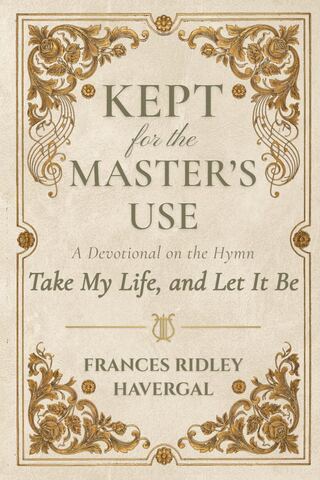
Some years later, Frances undertook to write out the full meaning of that covenant in prose. The result was Kept for the Master's Use — a short devotional book with one chapter for each couplet of the hymn.
It was published in 1879. She did not live to see it widely circulated. She corrected the last proofs from her sickbed only a few weeks before her death on June 3 of that year, at the age of forty-two.
If "Take My Life and Let It Be" is the hymn, Kept for the Master's Use is the commentary the author herself wrote on it — addressed directly to the reader, in Frances's characteristic style: intimate, searching, warm, full of Scripture, and never sentimental. It is the closest thing we have to her standing beside us as we sing.
What Made the Hymn Last
Many Victorian hymns have faded from common use. "Take My Life and Let It Be" has not. Several reasons help explain its remarkable durability.
It is concrete. The hymn names body parts and possessions — hands, feet, lips, voice, silver, gold. There is nothing abstract to hide behind. A singer who follows the words honestly is forced to think about real things in real life.
It is biblical. Almost every line echoes Scripture — Romans 12:1 ("present your bodies a living sacrifice") stands behind the whole hymn, but the individual couplets call up dozens of texts on the use of the tongue, the heart, the mind, the will.
It is personal but not private. The pronouns are first-person — my hands, my feet, my will — but every singer in the congregation makes the same prayer. It binds the church together by way of a shared individual surrender.
It is finished. The final couplet — "Take myself, and I will be / Ever, only, all for Thee" — closes the hymn with a totality that resists any half-measure. Once you have sung the last line, there is no further giving. That is its terror and its rest.
The Royal Rest
Frances Havergal had a phrase she used often, a phrase she borrowed from a meditation on the seventh day of creation, the day of God's own repose. She called it royal rest.
It was not the rest of inactivity. It was the rest of trust — the settled confidence that the One to whom she had given everything in the eleven couplets of her hymn was entirely sufficient to manage what she had given. This is what she most wanted to communicate to her readers, and it is what breathes through every chapter of the book she lived to finish but not to circulate.
Five years after writing the hymn, in the spring of 1879, Frances caught a chill returning from a visit to friends in Ireland. It became peritonitis. The illness was brief and the end was, by every account of those present, not a struggle but a peace. A few days before she died, when a friend read to her from 1 John 1 — "the blood of Jesus Christ his Son cleanseth us from all sin" — she looked up and said simply, "Wonderful."
On the morning of June 3, 1879, with her hand held by her sister Maria, she died. She had asked, not long before, that her friends would not grieve as those without hope. She wanted them to think of her as kept — kept for the Master's use, and then brought home.
The hymn she had written five years earlier in a sleepless February night had become, in the end, the description of her own life and death.
Frequently Asked Questions
Who wrote "Take My Life and Let It Be"?
Frances Ridley Havergal (1836–1879), a Victorian English poet and devotional author, wrote "Take My Life and Let It Be" in February 1874 at Areley House in Worcestershire, England.
What inspired Frances Havergal to write the hymn?
Frances had spent four days at a country-house party of ten people, quietly praying for the spiritual blessing of every person under the roof. By her last night, all ten — guests and servants — had been reached in some way and several had been brought to fresh faith. She lay awake too full of joy to sleep, and the hymn unfolded in her mind through the night.
What does "Take My Life and Let It Be" mean?
It is a hymn of total consecration — a line-by-line surrender of hands, feet, voice, lips, silver, gold, intellect, will, heart, love, and self to God. Frances Havergal called it "precise and costly gift," not vague aspiration.
Did Frances Havergal really give away her jewelry?
Yes. Within a few days of writing the lines about silver and gold, she sent her jewel-case to her clergyman to be distributed or sold for missions, keeping only a brooch of her parents and one piece her father had wished her to have.
Where can I read more about the hymn?
Frances Havergal's own commentary on every couplet of the hymn is found in her book Kept for the Master's Use (1879), the last book she completed before her death. Old Glory Press has republished the full text in a new edition.
Further reading: Who Was Frances Ridley Havergal? Poet, Hymn Writer, and Author of "Take My Life and Let It Be" — a fuller biographical sketch from Old Glory Press.
Read Havergal's Own Commentary on Every Verse
Kept for the Master's Use is the prose book Frances Havergal wrote to unpack "Take My Life and Let It Be" — one chapter for each couplet, completed only weeks before her death. The new Old Glory Press edition restores the full text.