“A bruised reed shall he not break, and smoking flax shall he not quench, till he send forth judgment unto victory.”
— Matthew 12:20
It is one of the gentlest sentences in the Bible, and one of the most easily skimmed. Both halves turn on objects nobody in the ancient world would have thought twice about throwing away.
The Reed
A reed is a hollow marsh plant. Whole, it has uses — a measuring rod, a pen, a pipe. Bruised, it has none. It will not bear weight, it will not stay straight, it whistles instead of sounding. The sensible thing to do with a crushed reed is to snap it and drop it in the water.
That is the point of the image. It is not describing something fragile and precious. It is describing something worthless — and specifically, something whose destruction would cost nothing and trouble nobody.
The Smoking Flax
Flax was what lamp wicks were made of. A wick that is smoking is one that has all but gone out: no useful light, and a thin acrid smoke filling the room. Anyone would pinch it out and be glad.
So the second image doubles the first. The one is useless; the other is worse than useless — it is an irritation. And the promise is that the Servant of the Lord will do neither of the obvious things: he will not snap the reed, and he will not pinch out the wick.
Where the Words Come From
Matthew is quoting Isaiah 42:3, from the first of the Servant Songs. Isaiah is describing the manner of the Lord's chosen Servant — not what he will accomplish, but how he will go about it. He will not cry, nor lift up his voice in the street. He will not break what is already broken.
Matthew quotes it at a particular moment. Jesus has just healed a man on the Sabbath, the Pharisees have gone out to take counsel against him, and he withdraws — healing the crowds that follow but charging them not to make him known. To a reader expecting a conquering Messiah this looks like retreat. Matthew's answer is that it is prophecy: this is what the Servant was always going to be like.
The gentleness is not a concession. It is the point.
“Till He Send Forth Judgment unto Victory”
The third clause is the one most often dropped when the verse is quoted, and it is the one that changes its character.
Judgment here does not mean a verdict of condemnation. It means Christ's righteous rule — his government, set up in a person and carried through. And unto victory means it will not stall.
Without that clause the verse is sympathy: Christ is kind to the weak. With it, the verse is a guarantee: Christ is kind to the weak, and he will not stop until the weakness is overcome. The bruised reed is not merely spared. It is healed.
How Richard Sibbes Read It
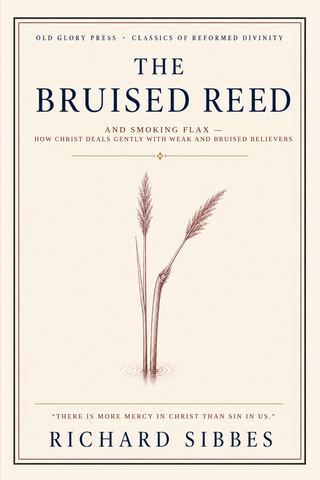
In 1630 the Puritan preacher Richard Sibbes published a course of sermons on this one verse. He took it in its three clauses and made of them a portrait of how Christ deals with weak believers — and the little book that resulted has never gone out of use.
Sibbes' reading turns on a distinction that is easy to lose. The bruising, he says, is not an accident that befalls a Christian; it is often God's own work, and it is for something. A man must be brought low enough to want Christ before he will actually have him. So the bruising is real and it is painful, and it is also purposeful.
What Sibbes then refuses to do is press the bruise. He is severe — genuinely severe — against comfort offered to someone who intends to keep the sin he is being comforted about. But to the person who is bruised because he hates his sin and cannot see how Christ could want him, Sibbes has one sentence he returns to again and again:
“There is more mercy in Christ than sin in us.”
— Richard Sibbes, The Bruised Reed
He also makes a point of the smoke. Where we see only the corruption — the smoke rising off a barely-lit wick — Christ, he says, sees the fire. He looks to what the grace will become rather than to what it presently is.
The Reader It Was Written For
Sibbes says plainly in his preface that he wrote for a particular kind of person: not the confident, but those “the chief ground of whose trouble was the want of considering of the gracious nature and office of Christ.” People, that is, who believed the doctrine and could not believe it applied to them.
It found them. Six editions in eight years; and among its readers a sickly, anxious teenager in Shropshire named Richard Baxter, who wrote long afterwards that the book had opened the love of God to him. Baxter became one of the most influential pastors England has produced.
Which is a fair illustration of the verse itself. What looked like a spent wick was, in fact, a fire waiting to be blown on.
Read the Whole Book
The Bruised Reed by Richard Sibbes — complete and unabridged from the 1630 first edition, with the three sermons he preached on the preceding verses, the Latin of the Fathers translated in the notes, and a new introduction.