How Christ Deals Gently with Weak and Bruised Believers — Richard Sibbes, with His Three Fore-going Sermons

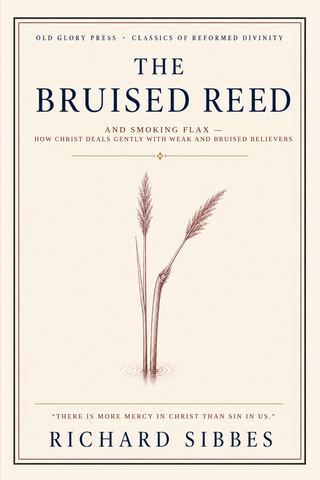
Originally published 1630 · Complete and unabridged · 120 pages · Paperback, Hardcover & Kindle
Also in hardcover → · and on Kindle →
You do not have to be strong for Christ to receive you. This little book was written for the weakest Christians — and it has been quietly doing its work for nearly four hundred years.
In 1630 Richard Sibbes published a course of sermons on a single verse of Matthew's Gospel: “A bruised reed shall he not break, and smoking flax shall he not quench, till he send forth judgment unto victory” (Matthew 12:20). The verse is the evangelist's application of Isaiah's prophecy of the gentle Servant of the Lord, and Sibbes takes it in its three clauses. The bruised reed is the sinner brought low, more sensible of his sin than of his Saviour. The smoking flax is the faint spark of grace in him, half-smothered by corruption and doubt. And the third clause is the promise that Christ will not leave off until that spark has become a flame.
Against every temptation to despair — from within, from Satan, from a heart that cannot believe Christ could love it — Sibbes presses one truth again and again: “There is more mercy in Christ than sin in us.” He is severe only against the false comfort that lets a soul rest easy in sin. To the bruised, the doubting, and the discouraged he is all tenderness.
The book was received so eagerly that it went through six editions in eight years. It was among the works God used in the conversion of the young Richard Baxter, who never forgot it, and it has gone on doing the same work for generations of readers since.
“There is more mercy in Christ than sin in us.”
— Richard Sibbes, The Bruised Reed
About the Author

Richard Sibbes · 1577–1635
Richard Sibbes (1577–1635) was known to his own generation as “the sweet dropper” and “the heavenly Doctor Sibbes,” for the honeyed, Christ-exalting warmth of his preaching. The son of a Suffolk wheelwright, he was educated at St John's College, Cambridge, and became a leading light of the Puritan “spiritual brotherhood”: lecturer at Holy Trinity, Cambridge, preacher at Gray's Inn in London, and Master of St Katharine's Hall.
Where much Puritan divinity searched the conscience with severity, Sibbes searched it in order to heal. He wrote for the faint-hearted, and no book of his shows that gift more perfectly than this one.
Read the full biography of Richard Sibbes →The Bruised Reed is a treatise on Matthew 12:20 — “A bruised reed shall he not break, and smoking flax shall he not quench, till he send forth judgment unto victory.” Sibbes takes the verse in its three clauses. The bruised reed is the believer brought low by a sense of sin; the smoking flax is the faint spark of grace half-smothered in him; and the third clause promises that Christ's government will carry that grace through to victory. Its one great theme is that Christ deals gently with weak and doubting believers.
Richard Sibbes (1577–1635) was an English Puritan preacher known to his own generation as “the sweet dropper” and “the heavenly Doctor Sibbes” for the warmth of his preaching. A Suffolk man educated at St John's College, Cambridge, he was lecturer at Holy Trinity, Cambridge, preacher at Gray's Inn in London, and Master of St Katharine's Hall. He was a leading figure in the Puritan “spiritual brotherhood.”
Baxter records in his autobiography that a copy of The Bruised Reed came into his father's house while he was a young man, and that reading it opened the love of God to him and settled his faith. He named it among the books God used in his conversion. The book had a similar effect on many others, including Thomas Goodwin, who came under Sibbes' preaching at Cambridge.
This edition is set from the 1630 first edition, complete and unabridged. It adds A Description of Christ — the three sermons Sibbes preached on the verses immediately before his text, printed in 1639 and not found in the standard modern edition. Sibbes' marginal Scripture citations and his Latin quotations from Jerome, Bernard, Gregory and Augustine are given in footnotes with the Latin translated, and there is a new introduction. The seventeenth-century spelling is gently modernized while Sibbes' own words, cadence and voice are preserved throughout.