
Most of the great Puritans are remembered for the weight of their arguments. Sibbes is remembered for his tenderness.
His contemporaries called him “the sweet dropper” — because, they said, his sermons fell like honey. Others called him “the heavenly Doctor Sibbes.” He never married, never held a bishopric, never wrote a systematic theology. He preached, and he wrote small books for troubled people; and three centuries later those small books are still in print while a great deal of weightier divinity is not.
A Wheelwright's Son from Suffolk
Sibbes was born in 1577 at Tostock in Suffolk, the son of a wheelwright. His father, we are told, would rather have set him to the trade; it was other hands that got him to school and then, in 1595, to St John's College, Cambridge. He took his degrees there, was elected a fellow, and in 1608 was licensed to preach.
Cambridge was where he was converted, under the preaching of Paul Baynes — himself the successor of William Perkins, the fountainhead of English Puritan divinity. It is a line worth noticing: Perkins to Baynes, Baynes to Sibbes, and Sibbes in his turn to men who would shape the next generation.
Holy Trinity, and the Cost of Plain Preaching
In 1610 or thereabouts Sibbes was appointed lecturer at Holy Trinity Church, Cambridge — the pulpit Perkins had made famous. A lectureship was a preaching post funded by subscription rather than by a parish living, and it gave men like Sibbes freedom to preach to the conscience. Under him the church had to be enlarged to hold the crowds.
It also cost him. Around 1615 he lost the lectureship, in the tightening climate against Puritan preachers under the Church authorities of the day. He left Cambridge for London.
Gray's Inn
In 1617 he became preacher at Gray's Inn, one of the Inns of Court, and there he stayed for the rest of his life. It was an unusual congregation: lawyers, judges, gentlemen's sons, the men who ran England's courts. Sibbes preached Christ to them in the same warm, searching way he had preached in Cambridge, and Gray's Inn became one of the most influential pulpits in the kingdom.
In 1626 he was made Master of St Katharine's Hall (now St Catharine's College), Cambridge — a house then much decayed, which he worked to restore — and he held both posts together, moving between London and Cambridge.
The Spiritual Brotherhood
Sibbes stood near the centre of what historians call the Puritan “spiritual brotherhood” — a network of preachers who wrote for each other's books, placed each other's students, and shared a common care for experimental, heart-searching religion. He was among the Feoffees for Impropriations, a group who bought up the rights to church livings in order to fund preaching ministries. Archbishop Laud had the scheme dissolved in 1633 as a Puritan stratagem — which, in the sense that mattered, it was.
He was not a separatist and not a firebrand. He stayed within the Church of England and worked, quietly and persistently, to fill its pulpits with preachers.
The Books
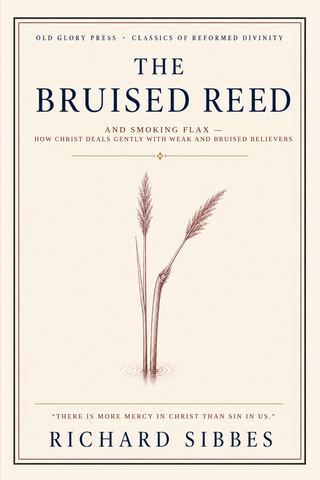
Sibbes published relatively little himself; much of what we have was taken down by hearers and printed with his reluctant permission, or gathered after his death. His best known works are The Bruised Reed and Smoking Flax (1630), The Soul's Conflict with Itself (1635), and the posthumous collections including Beames of Divine Light (1639).
Of these, The Bruised Reed is the one that has never gone out of use. It is a course of sermons on Matthew 12:20, and it was received so eagerly that it passed through six editions in eight years.
The Reader He Never Met
Sometime in the 1620s a pedlar came to a house in Shropshire and sold a poor man's family a book. The man's son, a sickly and anxious teenager, read it. He wrote long afterwards that it opened the love of God to him and settled his troubled mind.
The boy was Richard Baxter, who became one of the most influential pastors England has produced. The book was The Bruised Reed. Baxter named it among the works God used in his conversion — and Baxter's own Call to the Unconverted would in turn be used in the conversion of others, so that the line runs on out of sight.
Sibbes never knew. He also seems not to have known what his preaching did for Thomas Goodwin, who as a young Cambridge man came under his ministry and later became one of the leading Independent divines of the Westminster Assembly.
“There Is More Mercy in Christ Than Sin in Us”
That sentence, from The Bruised Reed, is as near as Sibbes came to a motto. It is worth being precise about what he meant by it, because it is easy to mistake for something softer than it is.
Sibbes was not indulgent about sin. He is severe — genuinely severe — against the false comfort that lets a man rest easy in a sin he has no intention of leaving. What he refused to do was to press a bruised conscience further down. He thought that a great deal of preaching drove weak believers to despair by demanding evidences they could not yet see, and he set himself against it. His pastoral instinct was to find the spark and blow on it.
“If I had gone about to affect writing in a high strain, I should have missed of mine end… For shall we that are servants quench those weak sparks which our Lord himself is pleased to cherish?”
— Richard Sibbes, To the Christian Reader
His Death
Sibbes died in July 1635 and was buried in the chapel at Gray's Inn. He was in his late fifties. He had never married, and he left his books and what money he had largely to the support of preaching and of poor scholars.
A couplet long associated with his memory catches how his friends thought of him:
“Of this blest man, let this just praise be given:
Heaven was in him, before he was in heaven.”
Why Read Him Now
Because the particular thing Sibbes did well is a thing that is still needed and still rare. Plenty of writers can tell you what you ought to be. Sibbes writes to the person who already knows what he ought to be, and knows he is not it, and is close to concluding that Christ must be finished with him.
To that reader Sibbes says, patiently and at length, that the smoking flax is not quenched — and that the God who lit the spark has undertaken to bring it to a flame.
Read His Most Beloved Book
The Bruised Reed — complete and unabridged from the 1630 first edition, with the three sermons Sibbes preached on the preceding verses, the Latin of the Fathers translated in the notes, and a new introduction.